Expect economic reforms to accelerate in China in the coming five to 10 years, propelling a shift to domestic consumption as the driver of growth rather than exports, but don’t get your hopes high for political reforms.
That’s the consensus of many China experts who observed the Communist Party’s 18th Party Congress, which closed this week with the selection of Xi Jinping as the successor to Hu Jintao as general secretary, and six other leaders who will rule the world’s second-largest economy.
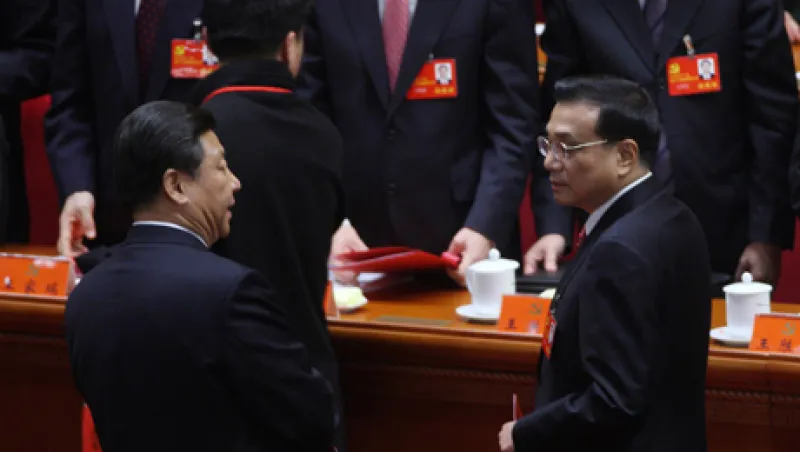
Joining Xi, the 59-year-old son of a Communist revolutionary, will be Li Keqiang, 57, the current vice premier. The two men will take over the reins of government in March after their formal appointments by the National People's Congress, with Xi succeeding Hu as president and Li taking over from Wen Jiabao as premier.
Xi earned a bachelor’s degree in chemical engineering and a doctorate in Marxist theory from Beijing’s prestigious Tsinghua University, China’s equivalent to the Massachusetts Institute of Technology. Li, who holds a law degree and a doctorate in economics from Peking University, will become the first Chinese premier who was educated in economics. Previous premiers have tended to come from engineering backgrounds.
The party also picked five others who will join the two on the Politburo Standing Committee, the nation’s ruling council: Chongqing party chief Zhang Dejiang, 65; Shanghai party chief Yu Zhengsheng, 67; Tianjin party chief Zhang Gaoli, 65; party propaganda chief Liu Yunshan, 65; and Vice Premier Wang Qishan, 64, who is also the nation’s economic tsar. The new committee has two fewer members than the previous nine-member group, which analysts believe should foster consensus building and facilitate decision making.
Except for former journalist Liu, the others served as provincial leaders over the course of their careers and are known for being economically liberal but politically conservative.

Their selection was the result of more than five years of back room maneuvers between the various factions of the party. Chief among them the sons of revolutionary leaders known as the “princelings,” such as Xi; younger officials who are members of party Youth League, like Li; and those who come from the “Shanghai faction” led by retired president Jiang Zemin, 86, who comes from Shanghai and remains a powerful kingmaker.
Several political reformers who were regarded as top candidates were not selected. They include party organization chief Li Yuanchao, Guangdong party chief Wang Yang and United Front party chief Liu Yandong, the only woman among the contenders.
Analysts expect the new leadership to push through economic and financial reforms now that the political uncertainty is over. Many local authorities have waited on the sidelines and have not implemented economic policies announced with the last Five-year Plan, which was passed by National People’s Congress in 2011. The plan incorporates a raft of economic reforms that allocate more resources to private enterprise and to inland provinces and accelerate the building of a national social safety net.
“I believe the conclusion to this contest will remove the political uncertainty that has been holding back the markets,” says Hong Kong–based Martha Wang, who manages $3.7 billion at the Fidelity China Focus Fund. “We will also see a pickup in the implementation of the Five-year Plan. Furthermore, I think the new leadership will be willing to accept lower GDP growth as it will focus on quality rather than quantity of GDP growth.” Such a shift aims to reorient the economy to reduce its dependence on exports and encourage more domestic consumption, analysts say.
On top of the financial reform agenda are renminbi convertibility, banking reforms that allow banks to set their own competitive interest rates and increase lending to the private sector, and allowing local governments to issue their own bonds.
Frank Yao, vice chairman of Asia at Neuberger Berman, says he expects economic reforms will take place at a measured pace. “China is a big country now,” Yao says. “Many people have put very high expectations on the new leadership. However, it will still take some time for reforms to take place.”
Take, for instance, interest rate liberalization. Chinese banks have traditionally followed interest rates set by the central bank. Reforms introduced in recent months have given banks some modest leeway to vary deposit and lending rates. Under consideration are reforms that will allow banks greater freedom to set their own rates based on market demand. “Credit markets still are dominated by commercial banks, and on the corporate side it is still really slow for bond issues,” Yao says. “Building credit markets with deep liquidity will take time — at least two to three years.”
Yao notes that the purge of Bo Xilai, who was Chongqing party chief until earlier this year, caught many people by surprise and indicated that politics in China still remained opaque.
Bo, who is awaiting trial, allegedly tried to cover up crimes by him and his family. His wife Bo Gu Kailai was sentenced to death with a two-year reprieve for murdering a British businessman.
China experts believe the real reason for Bo’s expulsion from the Chongqing party is because he openly challenged the succession plan and lost a power struggle with President Hu and party elders, including former President Jiang.
Though China may not reform politically any time soon, its leaders know very well they must accelerate economic reforms sooner rather than later.
The IMF forecasts China’s economy will grow by 7.8 percent this year, down from 9.2 percent in 2011 and the lowest since 2009. Data released in October indicated that year-over-year growth rate slowed to 7.4 percent in the third quarter, the lowest level in 14 quarters. The slowdown comes after eight consecutive quarters of a government credit squeeze aimed at slowing skyrocketing property prices, a boom that had been triggered by a 4 trillion yuan ($638 billion) fiscal stimulus in 2009.
“I see more market driven resource allocation,” Neuberger Berman’s Yao says. “This is very, very important. If you read President Hu’s speech to the Communist Party School on July 23, he says, ‘If we don’t take the reforms into next step we could risk losing power.’ This is very, very serious statement.
“If I remember correctly in past 35 years there were only two times Chinese leaders made this type of statement. First was 1978, when Deng Xiaoping said, ‘If we don’t start economic reforms, China will lose citizenship of earth.’ In 1992, Deng also made a similar statement, ‘If a leader doesn’t initiate reforms he should step down.’ We think the only way for China to take the next step is to deepen reforms. Fortunately Chinese leaders realize that.”