
As defense budgets in Europe reach record highs and overseas investors lose faith in the U.S. as a reliable partner, the Arizona Public Safety Personnel Retirement System is rethinking its global investment strategy.
“We’re reevaluating the world order,” Mark Steed, chief investment officer for the $24 billion retirement system, told Institutional Investor, adding that the pension fund is “actively analyzing” how to thoughtfully increase its international allocation while still placing a premium on the U.S.
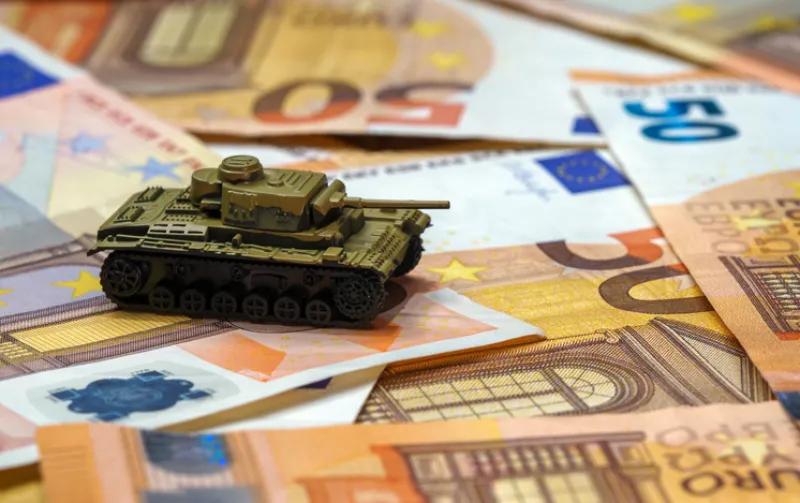
Defense spending in Europe reached a record €343 billion in 2024, up 19 percent from 2023. For the first time, investments in defense exceeded €100 billion.
The surge in fiscal spending will create manufacturing and technology jobs, potentially lifting GDP by up to 1.5 percent.
“It’s not just about direct defense investments but the multiplier effect on the economy, including innovation in dual-use technologies that spill over into civilian industries,” said Steed, who was the recipient of II’s Public Pension CIO of the Year award in 2024.
The Arizona retirement system currently has 15 percent of its portfolio allocated to international stocks (versus 27 percent for U.S. stocks). Steed and his team are having conversations about how to increase the pension’s exposure to international equities — whether passively to all countries or by targeting certain countries through active management. “You want to be picky about your exposures there,” he said.

Still, the hub of innovation “is overwhelmingly American right now and probably will be for some time,” according to Steed. “If you ask people to name the most innovative companies, I don’t think anybody would name a company in Europe.” So, Arizona is “still heavily focused on the U.S.”
Entering a New Order
Arizona’s rethinking started when Russia invaded Ukraine, signaling a shift from a U.S.-dominated economic system to a more fragmented world marked by disrupted global energy supplies and accelerated de-globalization trends.
“We’re starting to see deviations in paths that economies are taking” where “one economy zigs while another zags,” Steed said. “We’re no longer seeing coordinated fiscal activity. It’s all about reshoring and friendshoring supply chains.”
PSPRS is also focusing on countries implementing structural reforms (e.g., enhancing corporate governance, promoting wage growth); "Japan comes to mind," he said.
With investors in Europe increasingly anxious about the uncertainty of Russia’s next moves, many are beginning to question whether the U.S. can still be trusted as a dependable institutional partner and are weighing investments elsewhere. “A lot of these countries don’t feel comfortable hitching their wagon to the U.S.,” Steed said.
James Angel, a finance professor at Georgetown University, agreed that President Trump's unilateral actions will have major long-term consequences. “President Trump is clearly upsetting the old world order,” Angel told II in an email. “I don't think he appreciates the long-term impact of many of his actions.”
Like Steed, Angel warned that “the U.S. is no longer seen as a trustworthy and mostly peaceful partner.”
“After WW2, we were the good guys who helped save the planet from fascism and opposed totalitarian takeovers,” Angel wrote. “Now we are seen as greedy imperialists, trying to take other countries’ resources by military force.”