
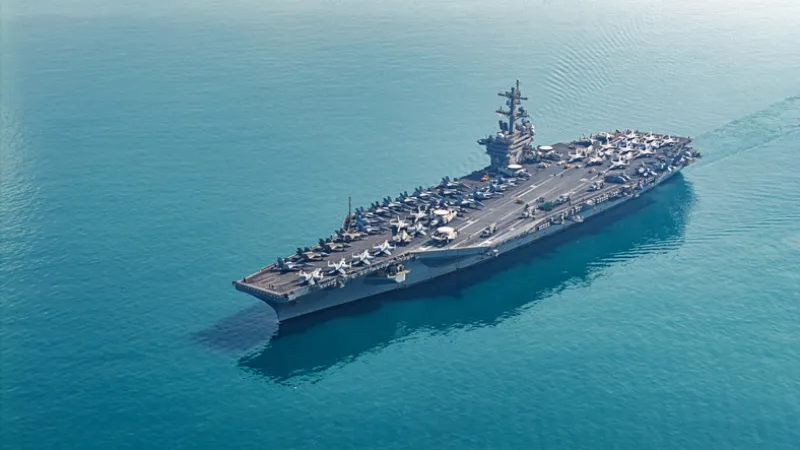
Following the U.S. and Israeli assault on Iran, allocators continue to invest in — and benefit from — defense and peripheral industries, despite the potential for backlash. In the current circumstances, Patrick Stutz, CIO at U.S.-based multi-family office Bayshore Capital, says it is crucial to put personal belief aside in the hunt for opportunity, or risk missing out.
“If you're in money management, you must work with the field that's in front of you,” he said. “You cannot say: ‘I don't like what's going on here, I'm just going to sit back and not make any investments.’”
Russia’s invasion of Ukraine in 2022 led Europe to increase its military spending. This in turn has helped global investments by private equity and venture capital in aerospace and defense more than double in 2025, rising to $10.63 billion from $4.88 billion in 2024, according to S&P Global Market Intelligence. The value of private equity aerospace and defense deals in Europe and the U.K. increased nearly fivefold year over year to $658.8 million.
With the threat of war potentially spilling into their borders, members of the EU have been building defense systems. “They’re close to Russia, and don’t know how that’s going to play out,” Mark Steed, chief investment officer at the Arizona Public Safety Personnel Retirement System, told Institutional Investor earlier this year. The $24 billion pension has been actively investing more in Europe to benefit from the increased defense spending.
“The state of the world being what it is, there are opportunities from an investment perspective, if you can stomach the prospects of some of those investments,” Brian Neale, chief investment officer for the $3 billion University of Nebraska Foundation, recently told Institutional Investor.
Several defense tech stocks have soared in recent months. The stock of Israeli firm Elbit Systems has grown by almost 70 percent in the last six months, following recent contract wins, while the stock of San Diego-based Kratos Defense & Security Solutions increased by 38 percent during that period.

And while Palantir is down 13 percent year-to-date as of March 3, Peter Thiel’s data driven defense startup enjoyed a massive spike when it signed a $10 billion contract with the U.S. Army in 2025. Analysts expect the stock to rise by as much as 40 percent on the back of the Iran invasion.
Tampa-based Bayshore Capital has made several successful bets on technology, infrastructure, hard assets, and critical minerals in recent years.
Bayshore invested early in NextSilicon, a semiconductor company based in Israel. Since the investment, the company has added several Western military clients that want to build supercomputers.
The ability to make these decisions hinges on the flexible asset allocation targets of the families the firm works with. “We're not forcing anyone into anything,” Stutz said. “We have some clients that are super enthusiastic about NextSilicon and others that say, ‘we don't need that right now.’”
“With NextSilicon, we knew that compute is a gigantic bottleneck with AI and with everything going on with the digitalization of the world, [but] we didn't invest in it to start wars,” Stutz said. “That is just the world we are in. The U.S., Russia, China — they all just do whatever is in line with their own interests.”
Stutz also said that some older private market investments are now benefiting from increased defense spending in the U.S., including mining company USA Rare Earth. The company’s stock spiked on Monday.