

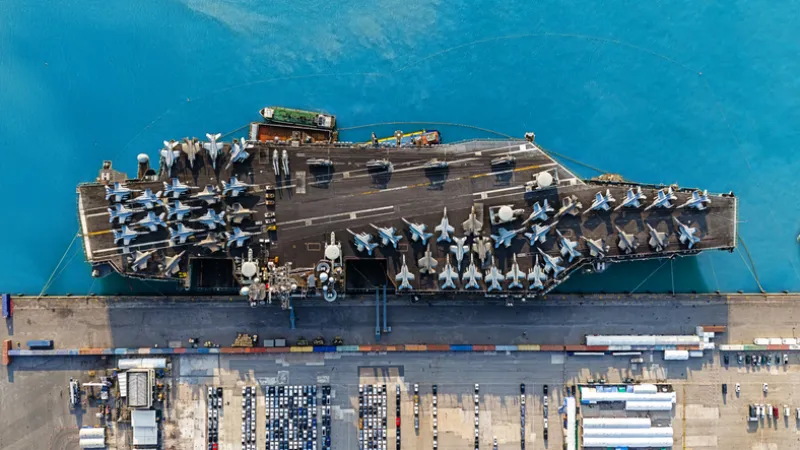
With the United States engaged in geopolitical conflicts on three continents around the globe, and U.S. defense spending near its all-time dollar peak, valuations of defense technology startups driven by AI have been soaring.
Last year, defense technology deals reached a record $49.9 billion, almost double the 2024 total, according to PitchBook. As Institutional Investor reported last year, the dramatic acceleration signals more than just increased capital flows; it represents a fundamental strategic recognition that defense technology companies are essential to national security and long-term geopolitical stability.
This year, PitchBook analysts argue that the sectors in defense AI to watch are maritime applications and drone swarms. Regular drones, which have become ubiquitous, are “oversaturated,” argued research analyst Ali Javaheri.
Josh Wolfe, co-founder of Lux Capital and a major VC investor in defense tech, agreed that maritime technology is likely to be a hot spot for investing. The size of that market is huge, he said, but “you have far less money on the venture side that’s gone into it.”
“Autonomous systems that can go places or do things where humans would otherwise be in harm’s way or danger are where investors are going to be,” Wolfe said. He cited sea and space as two of the most “unforgiving” environments.
According to PitchBook, autonomous systems in the unmanned aircraft systems sector took the largest share of investment and contracts in 2025. It named Anduril Industries’ Collaborative Combat Aircraft for the U.S. Air Force, which took its first flight last year, as one example.

Anduril, which launched in 2017, is now the most valuable VC defense investment. Worth $30 billion, it’s backed by such well-known VCs as Andreessen Horowitz and Founders Fund, as well as Lux.
Wolfe called the company’s autonomous jets the “loyal wingmen” accompanying a human fighter “scouting and identifying targets and seeing threats, and [going] places where it may not return.”
The company is also active in the maritime area, with its Ghost Shark and Dive programs. “They now are in every domain — air, land, sea, space, cyber,” said Wolfe.
PitchBook’s Javaheri said that the opportunity for investments in maritime autonomous systems is currently being driven by a trilateral agreement with Australia, the U.S., and the U.K. along with “rising cable-energy-infrastructure threats [that are] pulling autonomy beneath and across the waves.”
Wolfe agreed that the sea is a “huge opportunity for autonomous systems.” One third of Lux’s investments are in defense tech and some are actually crossovers. One example is Saildrone, which started out doing oceanographic research by sending its drones into hurricanes. The drones have since gotten bigger and added more technical capability, and the company now has a contract with the U.S. Navy.
Wolfe argued that there is an opportunity for more naval defense AI systems in part because the U.S. has lagged behind other countries, specifically China, in its shipbuilding capabilities.
Naval power is a strategic driver for new seed-stage VC as well, according to Javaheri, who said “there is also commercial upside around undersea cables and critical infrastructure. The navigation, communications, and rugged-environment challenges mean the field is still in its early stages and underappreciated.”
That is not the case with drones. Drone warfare became ubiquitous during Ukraine’s war with Russia, which triggered a surge of drone startups. “Dozens of new players” emerged during that conflict with “intense competition for contracts and manufacturing scale,” according to Javaheri, who said the area is “arguably overheated.”
But Drone swarms “are still hard to execute well [and] are an early investment opportunity,” he said. “The leap in edge computing and autonomy means land/ sea/air drone swarms can make decisions and coordinate without central control, enabling attritable systems [designed for potential loss] and new force multipliers.”