
By CME Group
At a Glance:
- While global FX remains highly fragmented, significant strides are being made to bridge the gap between over-the-counter (OTC) and futures liquidity in ways not previously available.
- Tools like FX Spot+ connect spot traders directly to deep futures liquidity while preserving their familiar spot workflows and tech stacks.
Hedge funds now hold a record $100 billion in FX futures positions. Asset managers have surpassed $200 billion. Trade friction, Middle East tensions and dollar uncertainty have reshaped the macro backdrop and forced a reassessment about what really matters when markets move.
Phil Hermon, Executive Director of FX Products at CME Group, explains the flows, the fragmentation and the products – including FX Spot+ – that are pulling OTC and futures markets into a single, interconnected liquidity pool.
The conversation has been edited for brevity and clarity. The full interview can be found here.
What are the two to three themes you're hearing most consistently from clients when they talk about their FX exposure right now?
The two macro themes resonating most consistently with clients are liquidity and optimization. On liquidity – specifically access to foundational liquidity – clients want to understand where price formation is happening and where risk transfer is available when stress events occur. The second theme is how to optimize their activity: how to get the most out of all the connections and marketplaces they have open to them globally.

The macro backdrop – dollar strength, rate divergence, geopolitical risk – has been unusually active. What are the flows and positioning data telling you about how clients are actually responding?
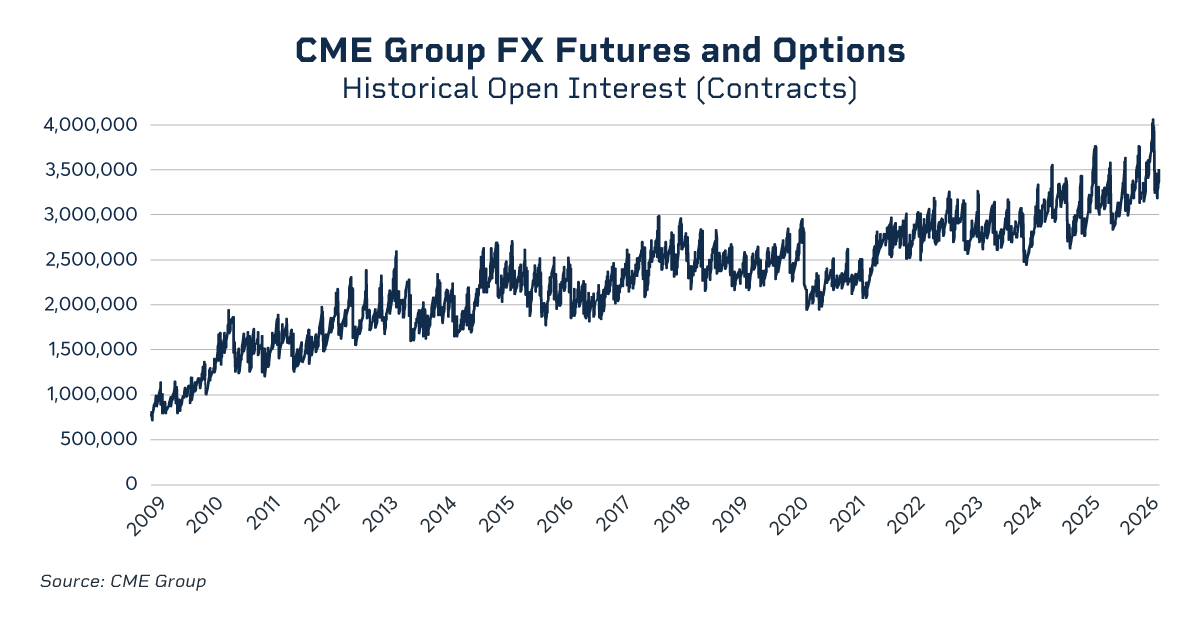
From a client positioning perspective, the FX futures business gives us perhaps the clearest lens, since client volumes and positioning are fully public. Looking at what we've seen in futures over recent weeks and months, a few things stand out. First, record all-time open positions from hedge funds of over $100 billion, followed by record all-time positions from asset managers of over $200 billion. In fact, overall FX futures and options open interest reached an all-time record of 4,410,167 contracts on September 4, 2026, driven by a record high of 1,446 large open interest holders. Those data points suggest either greater FX hedging from those client types or simply a broader adoption of FX futures overall.
Second, we've seen records in open interest or traded volumes across a wide range of currency pairs – including euro, yen, sterling, Aussie dollar and Norwegian krone – which speaks to the diversity of activity across markets.
Taking yen as one example: over the past 12 to 18 months, we saw a peak around April-May 2025 in asset managers holding long yen / short dollar positions. That position has significantly softened and unwound in the months since, and there is now essentially no structural position in yen – which reflects the broader dollar-strength sentiment in the market.
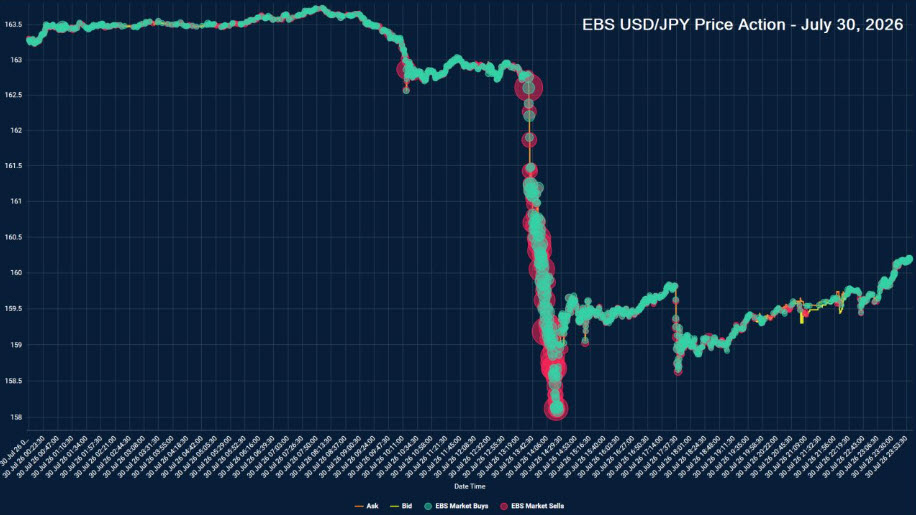
That lack of a structural position was stress-tested on July 30, 2026, when USD/JPY saw roughly ~$158 billion in total volume traded across our FX ecosystem, including ~102 billion in JPY Spot (EBS), the highest daily volume in over a decade, and ~$52 billion in JPY futures, an all-time record. The volatility also drove a record ~$10 billion in daily volume on CME FX Spot+, connecting futures liquidity in spot format to a wider range of clients.
The FX market is often recognized as one of the most fragmented of any major asset class. How has that fragmentation evolved, and what specific problem was FX Spot+ built to solve?
The FX market is widely understood to be the largest asset class in financial markets globally – and in my view, the most fragmented. Traders have an enormous amount of choice in where and how they transact and express their risk.
We've been working against that trend, trying to achieve some level of de-fragmentation. We've taken a number of approaches – FX Spot+, ERFP and FX Link. Focusing on FX Spot+ specifically: the core idea is to bring the market together by allowing OTC spot traders to directly interact with futures market liquidity and the futures ecosystem for the first time, but entirely in spot terms – trading spot, booking spot and settling spot. It gives spot traders access to futures liquidity and futures counterparts without requiring them to change how they operate.
FX Spot+ has seen notable adoption. What does that growth look like in practice, and what's driving it?
Since launching in April 2025, we're genuinely thrilled with how FX Spot+ has performed and the level of participation given everything that's happened in the world over the past 18 months. We've seen nearly 80 participants trading on the platform, with 39 banks new to FX futures. That's exactly the client segment we set out to serve.
There are two things underpinning that adoption. First, the ability for those participants to access futures liquidity in spot format – which removes a significant barrier to entry. Second, the ability to rest a spot order and have it distributed to the full universe of 95,000-plus traders in the FX futures market. Those two use cases are doing a lot of the heavy lifting in terms of driving engagement.
How are banks leveraging products like FX Link and EFRPs to navigate regulatory capital requirements?
The Standardized Approach for Counterparty Credit Risk (SA-CCR) – a regulatory framework introduced to standardize how banks measure exposure to counterparty default – has fundamentally changed the dynamics of bank capital – specifically how banks calculate and hold capital against their FX trading activity. EFRPs have given them an important new toolkit to work with. They allow banks to continue trading with clients on an OTC basis, maintaining and servicing those relationships in a low-touch workflow, while ultimately holding the risk off balance sheet in a centrally cleared derivative.
For banks and their clients alike, we see this as the best of both worlds: the flexibility of OTC trading paired with the capital efficiencies of central clearing.
What could the FX market look like 18 months from now, and what should firms be doing today to prepare?
The market you're trading 18 months from now won't look like the market you're trading today. The convergence between OTC and futures is continuing, and more products will emerge to bring these ecosystems closer together. The firms that recognize this convergence early and position for it are more likely to gain a structural advantage.
CME Group futures are not suitable for all investors and involve the risk of loss. Full disclaimer. Copyright © 2026 CME Group Inc.