Jim Iuorio, for CME Group
At a Glance
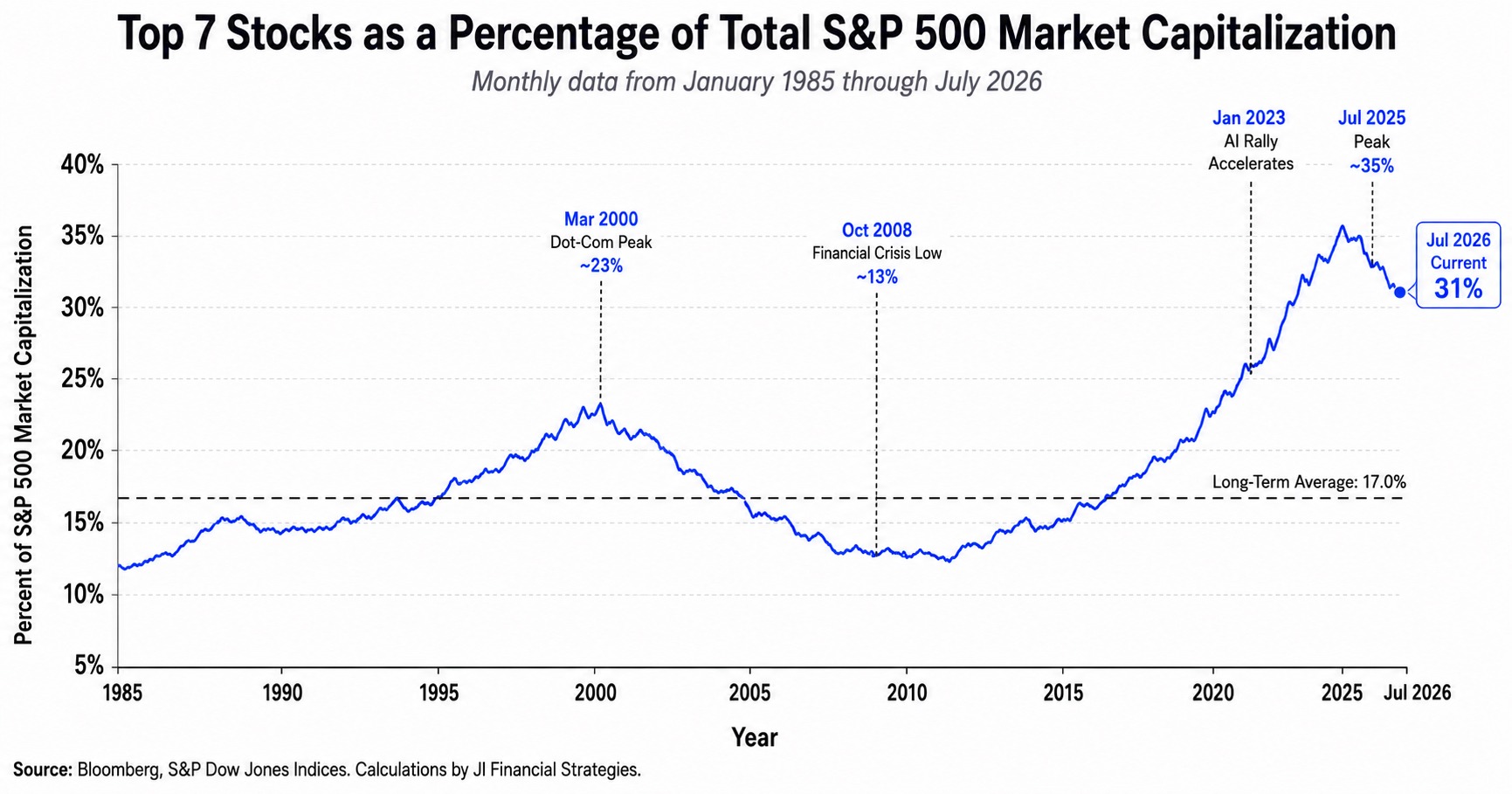
- The Magnificent Seven peaked at 35% of S&P 500 market cap in early June 2026, the highest concentration in index history.
- CME Group's Single Stock futures give investors a new capital-efficient, time-decay-free instrument to hedge individual equity exposure.
Since the beginning of 2023, the U.S. stock market has gained a cumulative 95%. Beneath that headline, however, one persistent characteristic has had analysts preaching caution: historically narrow market breadth.
A Rally Built on Seven Stocks
Over that same three-and-a-half-year stretch, the S&P 500 Equal Weight Index — which treats each company equally rather than weighting by market cap — gained roughly 50%. Meanwhile, the Magnificent Seven, comprising Alphabet, Amazon, Apple, Meta, Microsoft, Nvidia, and Tesla, returned a staggering 150%. Those seven stocks went from representing less than 20% of the index’s market capitalization to an astonishing 35% by the time the market reached its all-time highs in early June 2026.
For context, the average weighting of the seven largest S&P 500 constituents since the index’s creation in 1957 has been roughly 17%. The previous concentration record was approximately 26%, reached during the energy boom of 1980 and again, perhaps more ominously, at the peak of the dot-com bubble in March 2000. Today’s leadership has been completely unprecedented in modern U.S. market history.
Something Has Started to Change

Since early June, that extreme concentration has begun to unwind. Magnificent Seven’s collective share has fallen from roughly 35% to about 32%. The first beneficiaries were semiconductor stocks outside the mega-cap names. Companies like AMD, Micron, and Intel attracted aggressive institutional buying. By mid-June, the Philadelphia Semiconductor Index had rallied nearly 12%, even as the S&P 500 posted a modest decline, while the Magnificent Seven collectively fell approximately 15%.
When closely related sectors move sharply in opposite directions, it is worth paying attention. That type of divergence typically reflects a meaningful shift in positioning rather than broad market weakness. It may be the clearest signal yet that a rotation is underway.
That signal has since spread beyond semiconductors. Healthcare became one of the strongest-performing sectors in June. For most of the AI-driven rally it was largely ignored, but that dynamic appears to be changing. Large pharmaceutical companies, insurers and medical device manufacturers are attracting renewed interest on the basis of attractive valuations, stable earnings and dependable cash flows. In an environment where Treasury yields remain elevated and investors have grown more selective, those characteristics matter.
Financial stocks have also shown renewed strength. Banks spent much of the last two years under pressure due to commercial real estate exposure and an inverted yield curve. But if the economy continues to avoid a recession while longer-term yields stay elevated, the calculus changes. A steeper yield curve improves bank profitability, and continued economic resilience reduces concerns about credit losses. Many financial stocks still trade at meaningful discounts to the broader market despite improving fundamentals.
Together, healthcare and financials represent roughly one-quarter of the S&P 500. A rally supported by those sectors is fundamentally healthier than one carried almost entirely by seven stocks.
The AI Expenditure Question
There is also a legitimate question about whether the market is entering a period of AI capital expenditure fatigue. Artificial intelligence's long-term potential remains compelling, but the largest technology companies are expected to spend well over $350 billion on capital expenditures this year, much of it dedicated to AI infrastructure. At some point, investors may stop asking how much companies are spending and start asking how much those investments are earning.
Managing the Transition
The U.S. economy has continued to show surprising resilience. The labor market remains healthy, consumer spending has exceeded expectations and earnings growth has expanded well beyond the technology sector. The ideal outcome is not a collapse in the Magnificent Seven – it is a market where those stocks no longer have to carry the entire burden of leadership. However, a rotation of this potential magnitude rarely arrives without volatility.
For investors who want to manage that risk without abandoning long-term equity positions, a significant new tool is on the horizon. CME Group launched Single Stock futures in late July, with the initial offering covering many of the most consequential names in the current market, including the Magnificent Seven.
Unlike equity options, Single Stock futures carry no time decay, which makes a hedge less expensive to maintain over time. Unlike cash equities, going short is frictionless, with no need to locate or borrow shares through a brokerage. And like all futures markets, they trade nearly around-the-clock, which matters in a world where the most market-moving headlines tend to arrive after the closing bell.
For long-term investors who believe in this market but respect what a rotation of this scale could produce, that combination of capital efficiency, lower hedging cost and extended liquidity is worth understanding before the volatility arrives, not after.
Learn more about CME Group