

Sara Carter, CME Group
At a Glance:
- The repo market is increasingly defined by access: to clearing, central bank facilities, technology and ultimately to liquidity itself. An efficient market for financing and repo underpins the liquidity and bid/offer spreads of cash and derivative markets.
- Ensuring that access models, whether financing facilities or new technologies connecting participants, are simple to integrate and available to a broad range of counterparties will be essential to maintain functioning markets as debt issuance grows.
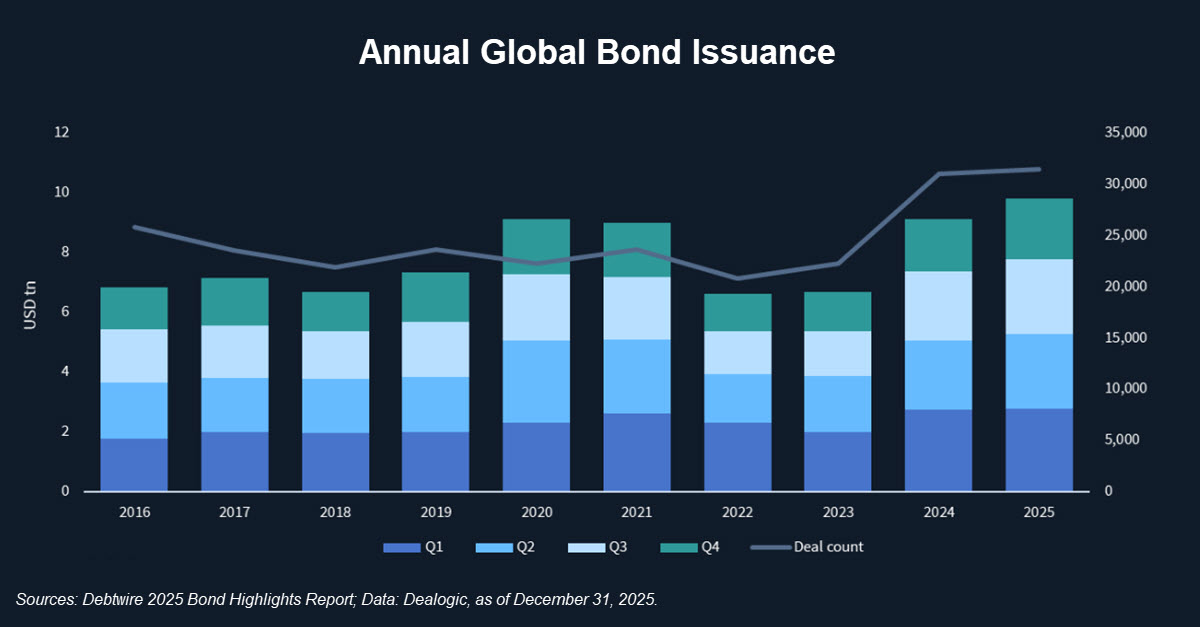
Global sovereign debt issuance – when a government issues bonds to finance their public spending – is expected to be high again in 2026, following a record 2025. As this issuance wave continues, and investor demand for government debt remains strong, it’s worth considering how this debt moves throughout the global financial system and its impact on the key parties involved.
Connecting Through Repo Markets
Repo markets are the plumbing behind sovereign debt distribution, ensuring bonds can be financed, hedged and reused as collateral.
The journey of sovereign debt begins with government auctions and syndications, where primary dealers (large banks) and wider market participants, such as buy-side institutions, purchase bonds, which are generally offered at a discount. Corporate bonds are similar, however, issued by a firm.

To avoid utilizing the bank's own capital and balance sheet, dealers "repo" the bonds – selling them to cash-rich institutions like money market funds with an agreement to buy them back at a specified future date (terms vary per market). While the cash bond market is an outright purchase or sale, the repo market is treated as a collateralized loan, meaning banks have to manage the associated credit risk of the underlying bond and counterparty during the term of the trade.
Government and corporate bonds, in addition to the risk positioning in outright markets, serve as collateral to finance longs/cover shorts for market participants and are utilized in margin calls. This plumbing further assists the breadth of market participants to cash reinvest, increase leverage, enhance returns and support market liquidity. The plumbing is sensitive to some friction:
1. Balance Sheet Pressure
Balance sheet pressure arises when capital requirements, deriving from the implementation of Basel Standards, such as the Leverage Ratio / GSIB / LCR / NSFR / HQLA / RWA / UMR, cause banks to actively manage their balance sheet accordingly in order to optimize each regulation. This allows them to increase balance sheet efficiency and reduce/increase exposures where required to manage dynamic regulatory constraints, thus requiring banks to tightly manage scenarios that impact their business.
The varying legal structure of each bank means the impact of measures of regulation cause different weighted balance sheet challenges for each of the banks. It is not one-size fits all. As banks navigate these challenges, it can mean they have diverging strengths, in their product offerings, at various points in the year compared to their competition. Thus, there can be situations whereby banks will be less willing to intermediate trades even if they have the cash or bonds, as they are constrained by the regulations.
2. Liquidity Stress
Simultaneously, liquidity stress can manifest when a surge in demand for cash suddenly spikes, and a contraction in supply is encountered, i.e. lenders become nervous – for example, due to heavy bond issuance or tax deadlines – causing interest rates to surge as participants compete for a dwindling pool of available funding. Additionally, collateral scarcity and sudden spikes in demand for specific bonds can cause pressures.
There have been a number of stress periods over recent years in the financing markets, which have highlighted the need to keep a liquid and functioning collateral market. Localized liquidity gaps can rapidly evolve into broader market contagion in the outright and ultimately futures markets. Consequently, the accessibility of central bank facilities and connectivity to intermediating technology venues becomes increasingly important as the speed of execution accelerates with technological advances and the market moves to faster, and increasingly automated, execution.
The Role of Central Banks
An efficient, functioning market depends on continuous access to secured funding, and central banks undoubtedly play a pivotal role, both by providing facilities for normal market conditions, and by promoting emergency facilities that play a market stabilizing role in times of stress.
In the U.K., the Bank of England’s Short-Term Repo (STR) and Indexed Long-Term Repo (ILTR) operations have become core to managing balance sheet pressure and liquidity stress. Access to these operations is now far more routine in an environment where Quantitative Tightening (QT) has reduced the amount of excess liquidity in the system. The bank has actively reduced the stigma associated with the operations.
Across major jurisdictions, usage patterns differ, but what matters most is that firms can connect to these tools in a straightforward and operationally efficient way. Even where access exists, technological integration and operational readiness determine how effectively participants can use these central bank facilities, particularly around periods of stress in the market and year-end, when balance-sheet availability tightens.
CME Group data shows clear seasonal patterns: March 2025 saw $407 billion in U.S. repo volume – the second-highest daily total on record – while European average daily notional volumes (ADNV) reached €350 billion.
The Evolution of Market Access
Participation in cash market infrastructure – be it central limit order books such as BrokerTec, request-for-quote platforms such as BrokerTec Quote or via clearing – improves access and choice for banks and their clients to manage their funding requirements.
As the U.S. repo market readies itself for mandatory clearing for certain repo transactions, the potential for increased use of clearing in the U.K. and Europe continues to remain an active discussion point. The clearing market in Europe is much more fragmented, adding an additional layer of complexity when considering clearing options or mandates in the future.
Additionally, the market structure of Europe and the U.K. are distinctly different to the U.S. where money markets play a much more significant role. The move toward central clearing for the buy-side is no longer just a regulatory hurdle; it is a liquidity strategy.
Today in the U.K. and Europe, barriers remain to the participation of investment managers in repo market clearing infrastructure. As a consequence, timing of execution and certainty of access differs between dealer-to-dealer and dealer-to-client flows. The access options from LCH and Eurex differ, with both offering different legal frameworks across sponsored and guaranteed clearing models. Ultimately, the selection of a clearing pathway is dictated by a firm’s membership status and the availability of bank sponsorship, a resource that remains constrained. Harmonizing these access points is essential for managers seeking to unlock the capital efficiencies inherent in netting.
As the clearing mandate in the U.S. increases global discussions on implementation, there is a deliberation on how, if and when the rest of the world will follow suit. A strategic pivot could be underway: market pressure could decouple from balance sheet capacity and intensify around capital constraints. Creating margin efficiencies will be paramount for a bank, but conversely, the amount of margin a bank receives could also decline.
The real unknown is the challenge the market faces in establishing a new paradigm. The participants need to ensure that quick access to movement of collateral can compensate for the reduction in margin received (e.g. the inability to rehypothecate collateral for margin efficiency).
While electronification has addressed many of the operational inefficiencies that once constrained repo trading, the next challenge is to ensure that this access is universal and frictionless, enabling collateral to move freely across the system even as sovereign supply continues to rise, ultimately creating a more resilient market.
Broad, uncomplicated access, rather than jurisdictional differences, will determine how well the market absorbs continued record issuance. Ultimately, in a world awash with government debt, the question is no longer whether liquidity exists – it’s whether everyone who needs it can reach it fast enough to keep the system flowing.
CME Group futures are not suitable for all investors and involve the risk of loss. Full disclaimer. Copyright © 2026 CME Group Inc.