
The first two papers in Dawson’s three-part Spotlight on Private Equity series examined how the asset class has evolved. Part 1 of the series looked at the sponsor toolkit: how the levers that drove returns have changed across successive eras and what needs to happen for private equity to return to performance more in line with the prior quarter century. Part 2 of the series examined private equity’s evolving role in portfolios, with Dawson concluding that recent moderation in returns is more likely temporal than structural and that the asset class continues to offer an attractive combination of return potential, diversification and stability.
Together, those papers made two arguments: the private equity playbook is changing, but the opportunity remains. This paper asks what follows from both.
We believe the next era of private equity will increasingly be defined by active management. If returns are generated less through leverage, multiple expansion and other historical tailwinds, more value may need to be created and captured by the participants themselves. Additionally, as the sources of returns become more varied, we believe the dispersion between those who adapt and those who do not has the potential to widen.
Importantly, this applies to both sides of the market. For GPs, active management can increasingly extend beyond the underlying asset to the fund and ultimately to the sponsor itself. For LPs, it can extend beyond manager selection and commitment pacing to the construction and ongoing management of their entire private equity portfolio.
We view there to be 10 levers that define this active management framework: five for GPs, spanning assets, the fund, technology, investors and balance sheet; and five for LPs, spanning allocation, portfolio construction, access, governance and technology (see Chart 1.0).
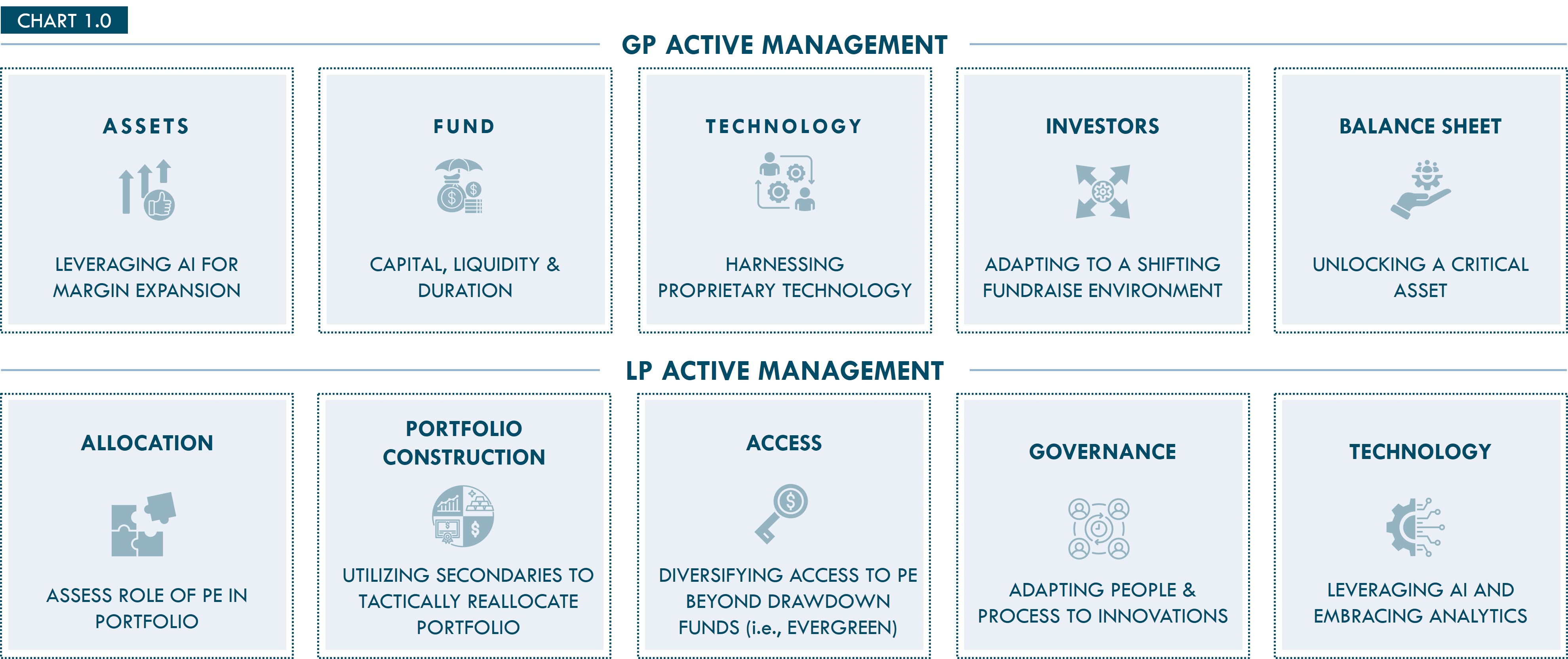
Together, these active management tools have the potential to provide GPs and LPs with something increasingly valuable in a changing market: optionality. In a market where outcomes may increasingly diverge, having more choices, to work on improving an asset, to seek liquidity, to raise capital, to buy or sell exposures and to respond when conditions change, and the ability to act on them, should carry a premium. In other words, active management tools can help convert opportunity into outcome.

This is the first portion of Part 3 of Dawson's three-part Spotlight on Private Equity series.
Click here to read the full paper, where we cover:
- Five levers in the active management framework for GPs
- Five levers in the active management framework for LPs
- Why we believe these 10 levers will be the key defining characteristics of private equity's next era
If you haven't read the full Spotlight on Private Equity series, explore the earlier installments below:
- Part 1 - The Evolving Private Equity Toolkit: What Got PE Here, Won’t Get It There
- Part 2 – The Evolving Role of Private Equity in Portfolios
Visit Dawson’s website to learn more about what we do.
Legal Disclaimer: Based upon Dawson's current views informed by historical data, published sources, other third parties and Dawson's proprietary database and analysis. Past performance is not indicative of future results. No assurances can be made that historical trends will continue or that expectations will materialize. Actual results may differ materially and should not be interpreted as guarantees of future performance. Note that an investor cannot invest directly in the broader private equity market and this paper is solely meant to be directional and for discussion purposes.