
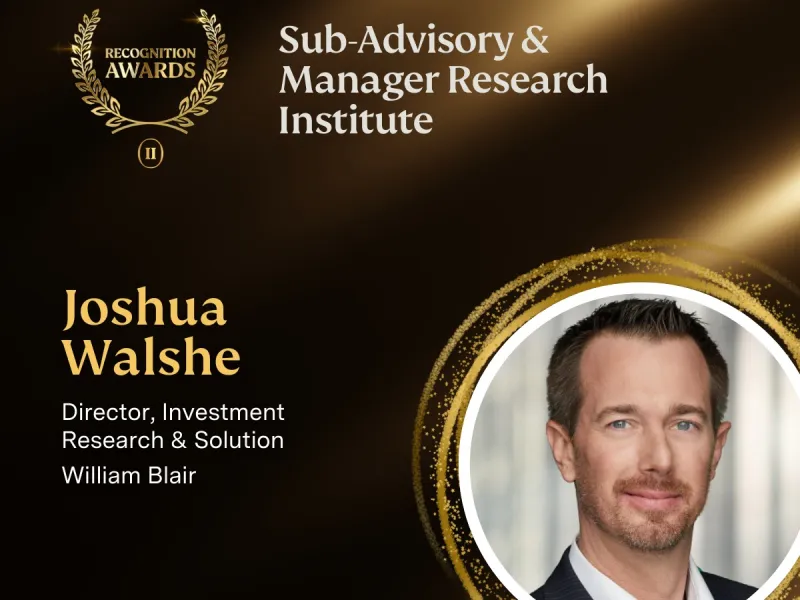
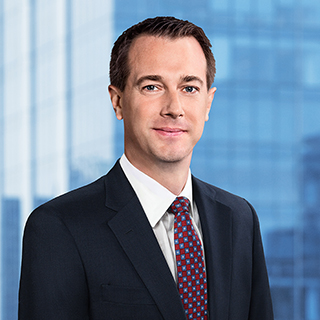
The Sub-Advisory Institute is recognizing 15 Next Gen and Industry Visionary Award Winners of the sub-advisory and manager research space this year for their leadership, innovation, and active participation in the investment industry. David Braham, Senior Executive Director, Thought Leadership & Market Intelligence at Institutional Investor, sat down with Next Gen Award Winner Joshua Walshe, CFA, Director, Investment Research & Solutions, William Blair.
Josh has differentiated his work by bringing out the best in his team. He first joined William Blair’s Private Wealth Management (PWM) group in 2018, and was originally based in Chicago, although he has since moved back to Dallas. Within PWM, under head of the PWM Consulting Services group Tyler Glover, he helped build out the Consulting Services Research Team, assuming the title of Manager PWM Research & Consulting Services in 2022, and Director, Investment Research & Solutions in 2025.
Josh received a Bachelor of Science in Business Administration at the Naveen Jindal School of Management, University of Texas-Dallas. After graduation, he joined the financial industry full time via a Lockwood Advisors office in Dallas, where he conducted investment manager research and analysis as an Investment Analyst within an advisor’s practice for more than seven years.
Prior to arriving at William Blair, Josh lived in Fort Worth, where he earned his MBA at Texas Christian University and worked at First Command Financial Services. During his nine years at the firm, he helped oversee $11 billion in managed account assets, more than 90 external managers, and a team of four investment professionals.
During the course of the interview, Josh shared his conviction in volatility, potential for the implementation and impact of AI in healthcare research and development, and rejection of accounting in favor of his client-focused work.
The following is edited for length and clarity.
 As you look back at 2025, what was the event that most surprised you and impacted your year?

It’s the adoption and implementation of AI in our daily work and workflows, and how it is being integrated across the industry. There’s the push and pull of what will work today and what won’t, knowing that today is likely the worst that AI will ever be going forward.
It’s the test of, “How can we make ourselves more efficient, more productive, and yet continue to use the little gray cells in our brain to think and prod and inform the qualitative and quantitative assessments that we do?”
What are you most excited about, personally or professionally?
Healthcare is an area I’m really excited to see how AI can streamline processes, come up with improved solutions, and provide new cures to a whole host of challenges. From a global health perspective, it will be fascinating to see how quickly advancements can be made.
Also, in the realm of machine learning, Ben Hunt of Epsilon Theory recently rolled out Perscient, and they’re looking to identify and understand narratives in unstructured data before those narratives hit the mainstream and potentially affect markets, or the world broadly. That fascinates me. Maybe we’re going through a period where investors can garner an information advantage, at least for a short time.
What type of leader do you want to be, and what skills do you want the people above you to have to make you better leaders?
It’s not just having one mentor: Putting together a group of people that you respect and want to emulate is key in developing skills and as a person – and then being able to pass along what you learn to the people on your team, especially those in the earlier stages of their career.
There’s a lot of data, and people often translate that data to knowledge. I think you want to go further and translate knowledge to wisdom and pass that along: That’s the core of what we’re looking for in our external conversations with managers as well as those we have internally as a team.
What made you want to work in the investment sector?
I’ve always liked math and finances but found accounting a bit too boring for me. I was baptized by fire into the industry as the 1990s TMT bubble burst, and that roller coaster of market volatility and the subsequent investor behavior fascinated me and ultimately hooked me for good. I like to reflect on the world, events, and markets, ask people questions, listen and think on their answers, and ultimately help guide investors to more positive outcomes.
It’s very rewarding to see the successes our investors have had, which drives me to wake up and do it again; every day seems like a bit of a puzzle, where we can work it out and find different solutions to our clients’ needs and customize accordingly.
As we look at 2026, what’s the one thing you want to achieve, and what’s the one thing you think is going to happen?
What’s going to happen is volatility, either a little bit of it or a lot of it. The world is a very uncertain place, and at the end of the day, we’ll be coming in, looking at many different paths that we can go down and outcomes that could happen, and prepare for a very different world with an eye for delivering a sense of stability to our clients.
I think staying flexible and being prepared – not anchored to one specific outcome – is probably the best way to make your way through 2026.
Who do you want to have dinner with this year?
I’ll go with Barack and Michelle Obama: plenty to pick their brains on.
Market Intelligence is independent of the Institutional Investor Magazine Newsroom.