
With the stock market at exhilarating heights, any sign of weakness raises fears of another financial crisis. No wonder market prognosticators are asking: Could we soon face a repeat of 2008 or 2000?
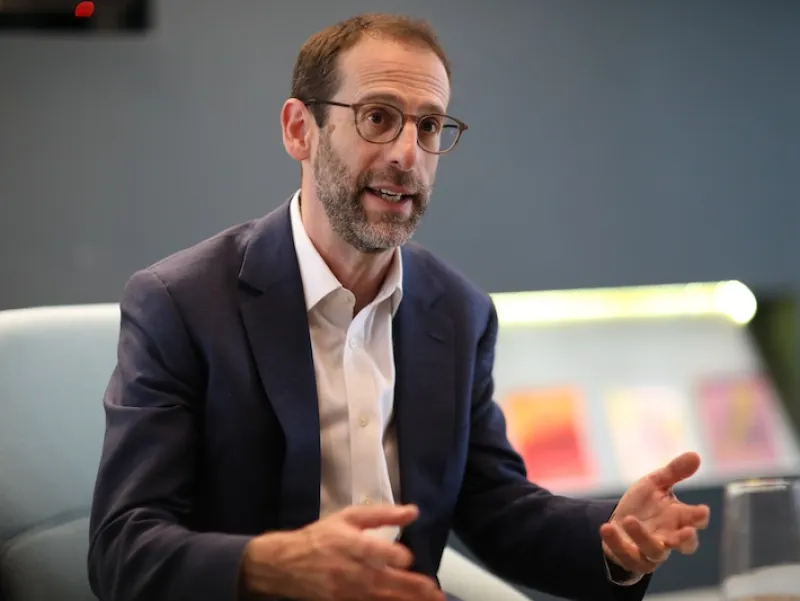
Marc Rubinstein, a former London-based hedge fund manager and bank analyst, thinks we should go back even further, past the infamous stock market crash of 1929 — to the Bankers’ Panic of 1907.
“While there are echoes of 1929 in today’s markets, especially around retail participation in the market, it’s another historical episode that may offer even more relevant parallels,” Rubinstein wrote recently in his Substack newsletter “Net Interest.” As he puts it, “The Panic of 1907, where shadow banking created systemic vulnerabilities, captures crucial features of our current financial system that the 1929 crash doesn’t illuminate.”
In the more than five years since Rubinstein launched “Net Interest,” the former hedge fund manager has made a name for himself analyzing systemic risk, from the boom in multistrategy hedge funds to the growth of the private equity industry and its transformation of the insurance industry. He says of the latter development, “The question isn’t whether [this] model works — it demonstrably does — but whether we fully understand all the ways it could break.”
The same might go for all the newfangled ways finance has been structured — or deconstructed, as Rubinstein says — outside of the regulatory regime that constrained the big banks after they tanked the global economy in 2008. There is some $70 trillion in the so-called shadow banking system, which Rubinstein argues includes hedge funds, private equity, insurance, private credit, and trading firms. Many critics think of the shadow banking system as private credit.

“Now 50 percent of financial assets are somehow touched by shadow banks rather than regulated banks,” he tells Institutional Investor. The same percentage existed in 1907 leading up to the bank panic.
Rubinstein adds: “It’s not the risky thing that is known to be risky that causes the real crisis. It’s the stuff that everyone thinks is safe.”
Born and raised in Liverpool, England, Rubinstein was the first in his family to work in finance. His Eastern European Jewish ancestors immigrated to England in the 1880s and prospered. One grandfather played the cello professionally, and the other was a cabinet maker. Rubinstein’s father was a professor of pharmacy. Rubinstein says he did not inherit the music gene — “I’m tone-deaf” — but a facility with mathematics earned him entrance to Oxford University, from which he graduated in 1994. Like many U.K. graduates, he quickly went to work in the booming City of London.
His first stop was as a banking equity analyst at BZW, then the investment banking arm of Barclays Bank. Rubinstein then went to Schroders, the British asset management company, before moving to Credit Suisse, where he was a managing director and head of the European bank’s equity research team for more than six years.
In 2006, just ahead of the financial crisis, Rubinstein joined Lansdowne, one of the biggest European hedge funds, where he was a partner, senior analyst, and portfolio manager of the Lansdowne Global Financials Fund, investing in global financial firms for almost ten years. (Shorting banks with subprime mortgage exposure helped earn Lansdowne a top long-term European hedge fund performance award in 2010.)
At the time the fund was launched, Rubinstein says, financials made up 20 percent of the MSCI. But after the financial crisis, the sector shrank, restructurings and merger plays were limited, correlation increased, and opportunities vanished. “Post-2011, it was really a single trade around two things, interest rates and regulation,” he explains. The fund was wound down in 2016, and Rubinstein left the world of hedge funds for good.
Since 2018, he has been a managing partner at Fordington Advisors, offering advice to financial institutions and investment firms, as well as an angel investor in fintech start-ups and an investor in a smattering of hedge funds. He has no desire to go back to working in a hedge fund. “It requires a level of obsessiveness that is hard to sustain,” the 54-year-old admits.
Rubinstein says most of his time is spent writing his weekly Substack and a less frequent finance column for Bloomberg Opinion. “Net Interest” is where his most intriguing analyses are found. Indeed, it was a piece there on the reasons for the 2021 collapse of Silicon Valley Bank that put him on the map.
Now Rubinstein is essential reading for finance geeks. With almost 97,000 subscribers, “Net Interest” is a top-20 finance Substack. (Not all readers have forked over the $300 per year it costs for a paid subscription, but Rubinstein says he makes a living from it.) He also has done podcasts with a number of financiers, including former partners of Long-Term Capital Management, analysts from Goldman Sachs, and executives from Blackstone.
Rubinstein calls himself a critic and a skeptic because “it’s important for an analyst.” He is a conservative investor and a cautious man who is wary about predictions: “It’s very difficult to know what the catalyst is going to be in any of these crises.”
And he notes that not all stock market crashes are tied to systemic issues. For example, there was no systemic meltdown in 2000, when the dot-com bubble burst. It’s systemic, he notes, only when the troubles ripple through the banking system.
That’s where his analysis of the Panic of 1907 informs today’s world. Many people are not familiar with the crisis, which led to a bailout of banks engineered by J. Pierpont Morgan. But Rubinstein is a keen student of history. As he explains, the 1907 panic is relevant now because “one of the big features of the financial marketplace today is these shadow banks, which have grown materially since 2009 because of the tighter regulation that has been imposed on banks.”
Those regulations have allowed shadow banks to take market share in everything from basis trading, which used to be the purview of the big banks but is now done by hedge funds and trading firms, to lending, half of which is now done by the private credit arms of PE firms instead of by banks.
The shadow banking system has grown so huge that another finance maven, Michael Green, chief strategist and portfolio manager at Simplify Asset Management, quips that there is no “shadow banking” anymore — arguing that it and the regulated banking system have become so intertwined as to be virtually indistinguishable.
Rubinstein sees a parallel to the trust banks at the turn of the 20th century. For two decades leading up to the 1907 panic, trust companies emerged as rivals to the more heavily regulated banks — the private equity and private credit firms of their day. “Because they weren’t directly involved in the payment system, their cash reserves didn’t have to be as high,” explains the former bank analyst. “They ran more concentrated portfolios, and they were able to show higher returns” by investing in equities and advancing credit.
“In 1890, they were doing half the lending of the New York banks,” he says. “Then by 1906, they were doing the same amount.”
As is often the case, Rubinstein says, the beginning of the panic seemed benign. “It started with a scandal involving a group of individuals [who] tried to corner a market.” One of them had borrowed money from Knickerbocker Trust, one of the biggest trust banks in New York, and could not repay it. “And that’s when things started to unwind,” Rubinstein says. “There was a run on Knickerbocker Trust that saw outflows of $8 million in the space of two and a half hours. That was a lot of money in those days.”
More to the point, “about $1.5 million of that was from a bank that had deposited its own funds [in Knickerbocker],” he says. “So you can call it interbank lending with Knickerbocker Trust. And the interconnections between the nonregulated and the regulated financial firms wasn’t transparent at the time.”
That’s also a concern today, especially as the interconnections grow. “The big growth area for bank lending just this past 12 months has been lending into that nonbank sector. It’s 10 percent of their loan books — and all of the growth this year,” Rubinstein says.
The Panic of 1907 led to the creation of the Federal Reserve, which has been used to stem every financial crisis since then. Rubinstein is not predicting one anytime soon, as he says that timing is impossible to foresee. But he is pointing out the vulnerabilities of the system.
One such vulnerability involves private equity’s move into insurance. The strategy, which has picked up steam in recent years, was brilliant, according to Rubinstein. Some firms — like Apollo, KKR, and Brookfield — bought insurance companies outright, and others, like Blackstone, have taken small stakes or manage insurance company assets. Many private equity firms also have bought reinsurers, allowing them to offload some of their risk to entities in offshore locales — essentially a way to add more leverage to the system. According to Rubinstein, “ceding business offshore in a so-called ‘asset-intensive reinsurance’ transaction can reduce the amount of capital and reserves required to back the business by about 40 percent.”
At latest count, private equity firms control more than 11 percent of insurance assets. When the strategy works, it’s “phenomenal,” Rubinstein says.
“One way of thinking about asset management is that you have got an edge as an asset manager in making money. So in order to scale that, you’ve got to recruit assets,” he explains. “Everyone thinks the hedge fund model is amazing because you get 20 percent of the profit. But on the other hand, if you are this amazing asset manager, you might think, hang on. You’re giving up 80 percent. Warren Buffett identified a long time ago that one of the advantages of insurance liabilities is you can run them and you can take [almost] 100 percent of the profit.”
Many private equity firms got into insurance by buying blocks of annuities from life insurers. “It was a phenomenal trade-off at the time because they took advantage of a disconnect in the market post–financial crisis. They had pricing on their side when they bought these assets. The insurance companies themselves were completely upside down,” says Rubinstein. They had promised high returns but because of the plunge in interest rates were invested in low-yield fixed-income assets.
The private equity owners that took over these assets invested them in higher-return fixed-income instruments, including securitized products that can allow for a significant amount of financial engineering to reduce capital requirements — yet another boost to profits.
But is it too much of a good thing? “What started as opportunistic investing during the 2008 crisis has evolved into a sophisticated financial machine that blurs the lines between asset management, insurance, and banking. The question is whether this complexity creates new risks or simply redistributes old ones,” Rubinstein says.
He argues that the biggest problem of this model is its opacity. “Banks are now so heavily regulated, — and even then, you don’t really know what’s going on inside a bank. Insurance is even more opaque. And increasingly, there’s a lot of cross-holdings of assets.”
Rubinstein notes that the risk such interrelationships pose is the reason commercial and investment banking were separated in 1933 via the Glass-Steagall Act (a law that was scrapped in 1999). Then, in 2000, research was walled off from investment banking following a series of scandals leading up to the dot-com crash. “That separation hasn’t happened yet in private equity and insurance,” Rubinstein says.
Even before the more complicated arrangements of the private equity insurance model, sizable blowups in insurance were not uncommon. AIG, for example, almost went under during the 2008 financial crisis and had to be bailed out by the federal government. In the early 1990s, California’s Executive Life Insurance was taken over by state regulators following its ill-fated foray into junk bonds.
The private equity model “can scale, but there’s a point at which maybe there are questions that have to be raised,” Rubinstein asserts.
Size and growth are two issues he returns to often in his analyses. A case in point is the exploding growth of multimanager, multistrategy hedge funds. Rubinstein, who has invested in some 40 hedge funds, posits that such funds are “systemically important and maybe too big to fail.” (None, however, have been designated as systemically important financial institutions by regulators.)
Historical comparisons, a relatively new phenomenon, are hard to come by. Even so, Rubinstein brings up Long Term Capital Management, the heavily levered hedge fund that collapsed in 1998 and was bailed out with a $3.6 billion lifeline from a group of 14 banks. That number seems small today, but at the time, LTCM was huge — and touched almost every asset class.
“They weren’t a multimanager fund in the sense that they ran a single book, but within that book, they ran lots of different strategies. They were just bigger than anyone anticipated. They had a massive footprint on the market and across multiple different markets. And through them, they created correlation because if they were forced to unwind their merger arbitrage positions it had an impact on those markets,” says Rubinstein. Some of the markets they invested in were unconnected, but because the fund was forced to liquidate across markets, “they became connected,” he explains. “And that’s systemic.”
To buttress his argument that there are lessons to be learned from LTCM, Rubinstein notes that Citadel’s Ken Griffin has said he went to visit the LTCM founders to learn from their experience. Since facing huge losses during the financial crisis, Citadel revamped its risk management and took off, becoming a top multistrategy fund today.
Today multistrategy hedge funds have “successfully industrialized the investment process,” says Rubinstein.
But with more than $1 trillion in gross exposure overall, multistrats face one of their biggest risks from this stupendous growth, Rubinstein argues. “These firms have got more money than they know what to do with.” Indeed, he notes, some multistrategy funds have begun to invest in other multistrategy funds instead of putting more capital to work with their own teams. Some also return capital to investors on a regular basis.
“The forty or so firms that operate the multimanager model may command only 8 percent of hedge fund assets, but, according to Goldman Sachs, they account for 27 percent of the holdings of U.S. equities (up from 14 percent in 2014),” Rubinstein wrote in 2023. Since then, their impact on markets has only grown.
“Think about the correction that would be invoked if they were just to disappear from markets,” Rubinstein tells II. For example, “Citadel also has its market-making business, and that’s a separate arm’s-length business. But collectively, that’s a pretty impactful, pretty powerful entity. Probably more powerful than Goldman Sachs ever was in its day on the trading side.”
Rubinstein knows it’s difficult to have a financial system that eliminates all probability of a financial crisis. And there is an imperative for most players to stay invested. “No long-only manager will go to cash,” he says. “They’re forced to continually invest.” In addition, flows into passive vehicles are a source of constant investment.
So while the vulnerability is “very clearly there,” Rubinstein says, looking to history for answers goes only so far.
“No one knows where the next crisis is going to come from,” he says. “But I think we can be as close to a hundred percent as you can be in markets that it’s not going to be caused by subprime mortgages.”