

Bridgewater Associates just posted the biggest gain in its flagship strategy since 2010 and one of the best results in its 50-year history.
Pure Alpha 18 Percent gained 34 percent in 2025, according to someone who has seen the results. It has compounded at 11 percent over the past three years and 10 percent over the past five years.
The hedge fund giant’s other funds also enjoyed strong results last year: All Weather 10 rose 20 percent, Asia Total Return 15 (USD) jumped 37 percent, AIA Labs 15 grew 11 percent, and China Total Return (USD) Strategy gained 34 percent.
Entering 2026, the firm is confident it is well positioned.
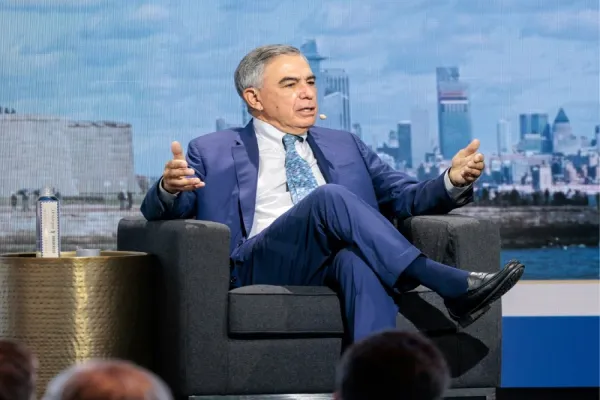
“The markets are entering a period of easing monetary policy and transformation of technology,” Greg Jensen, co-chief investment officer at Bridgewater Associates and a director on Bridgewater’s operating board of directors, told Institutional Investor in a recent phone interview.
“Looking ahead to 2026, the firm sees a risky environment for many investors,” said Jensen, who is also the managing CIO for Alpha Engine — which is responsible for the firm’s Pure Alpha strategy — and for AIA Labs. “The combination of easier monetary policy next year against the backdrop of transformational technology creates fertile ground for a potential bubble. Bubbles are hard to navigate and create risks for many investors, as there can be many major drawdowns even as markets rally to new highs. But in this risky environment, Bridgewater also sees opportunities as it has been focused on building a leading understanding of the AI capex boom and how it is affecting economies and financial markets.”

Bridgewater has made a number of management and process changes over the past five years.
These started in 2020 when founder Ray Dalio moved out of the investment decision-making role and an investment committee was created. In 2022, Nir Bar Dea and Mark Bertolini were named co-chief executive officers. Bar Dea then led a major restructuring in 2023. At that time, Bertolini stepped down as co-CEO and became an independent director. Today Bar Dea leads the firm with co-CIOs Greg Jensen, Bob Prince, and Karen Karniol-Tambour.
That same year, the firm created AIA Labs, described as a dedicated group within Bridgewater whose goal is to use artificial intelligence and machine learning to generate returns in the market.
In 2024, with the goal of personal accountability, Bridgewater gave each of its three CIOs responsibility for a specific area. Jensen is focused on the firm’s Alpha Engine (Pure Alpha and AIA), Prince on portfolio resilience, and Karniol-Tambour on Asia strategies. In addition, Bar Dea oversees organizational overall leadership. Other key management changes: Erin Miles is now head of Alpha Engine; Sean Macrae is head of research for Alpha Engine; and Blake Cecil, Ben Melkman, and David Trinh are deputy CIOs.
Bridgewater also capped the firm’s assets under management — which stood at $92 billion at the end of September 2025 — returning assets to certain clients to give it more flexibility. And it expanded equity ownership from just 1 percent to more than 60 percent of its employees. “The changes we’ve made have ensured we are able to remain uniquely nimble and diversified, and we’ve been seeing the benefits of our strategy unfolding,” Jensen said in the interview.
The firm stresses that its systemic expert systems are the foundations for the next AI step, which it has been working on since 2012. It notes that all of its strategies are benefiting from their progress in AI, but in different ways. In AIA, humans train the machine that determines the rules. In the other strategies, AI techniques allow humans to systematize human intuition more efficiently.
“Since 2012, Bridgewater has aggressively pursued the vision of the artificial investor that can do everything a human can, with computers not just representing the insights but also generating the insights themselves,” Jensen said.
These days, Bridgewater is tracking three main themes that it deems “the most transformational technologies ever”: modern mercantilism, which it believes is the biggest global economic change since World War II; extensive portfolio concentrations in U.S. assets; and artificial intelligence.
In a recent Wall Street Journal op-ed, Jensen explained that modern mercantilism is built on four tenets. First, that the state plays a large role in orchestrating the economy to increase national wealth and strength. Second, trade balances are an important determinant of national wealth and strength, and trade deficits should be avoided. Third, industrial policy is used to promote self-reliance and defense. And fourth, national corporate champions are protected.
Behind this analysis is the view that China was in many ways the original mercantilist, using extensive industrial policy and state orchestration of the economy to become a global leader in manufacturing. This created a set of social, economic, and political pressures that have caused the U.S. to follow in a mercantilist direction. Both countries’ embrace of modern mercantilism are now creating more pressure on Europe to follow and either use government policy to support its industries or have its businesses face major competitive disadvantages.
“As part of modern mercantilism, the push for resilience over efficiency will impact productivity, government policy will play an increasing role in driving growth, and there will be a new set of winners and losers as the global economy is actively reshaped,” Jensen noted.
With all this in mind, Bridgewater is heading into 2026 prepared to confront several key potential developments. “It will be extremely complex and dangerous for many investors,” Jensen said.
He said the firm is watching the decay of institutions such as the Federal Reserve, the judicial system, and international organizations. This will have a big impact on the bond market, which, Jensen said “has the worst supply in aggregate ever,” adding that the private sector needs to buy bonds in an uncertain world where central banks are losing power. “Continued use of fiscal policy could lead to more inflation.”
Jensen worries that this could be “a dangerous year for interest rates” as the Fed tries to lower rates, which “could lead to a bubble and hurt the long end.” He is also watching the development of AI, which will result in winners and losers, as well as how nations will deal with tariffs as countries like Germany and Japan build up their militaries.
Jensen concluded: “We are entering a period of easing monetary policy and transformation of tech which could lead to bubble dynamics. We don’t know the turning point, but there will be major equity drawdowns along the way.”