

By Tom Osborne, Executive Director, Infrastructure (North America)
America’s infrastructure underpins every aspect of economic and social life, from the roads that connect goods and markets, to the energy, water and digital systems that households and businesses rely on every day.
But despite this, much of the nation’s infrastructure is ageing and overstretched. Public funding alone cannot meet the scale of renewal required. As pressures on government balance sheets intensify, we believe mobilizing long-term private capital - particularly pension capital - has become urgent.
For institutional investors who invest for the long term, renewing US infrastructure presents a capital allocation question of growing relevance as they seek to diversify portfolios in the face of geopolitical uncertainty. Drawing on nearly 30 years of experience investing in and managing infrastructure assets on behalf of long‑term institutional investors, IFM’s perspective reflects lessons learned across multiple market cycles and regulatory environments globally.
IFM Investors’ new policy blueprint, Revitalising US Infrastructure: The Pension Capital Advantage, positions investors managing retirement savings as a possible solution to help close the US’s infrastructure funding gap while delivering tangible benefits for communities, workers and retirees alike.
With targeted policy reform, pension capital could play a far greater role in renewing US infrastructure over the coming decade – while also providing new investment opportunities to grow the long-term retirement savings of working people.

The scale of the challenge
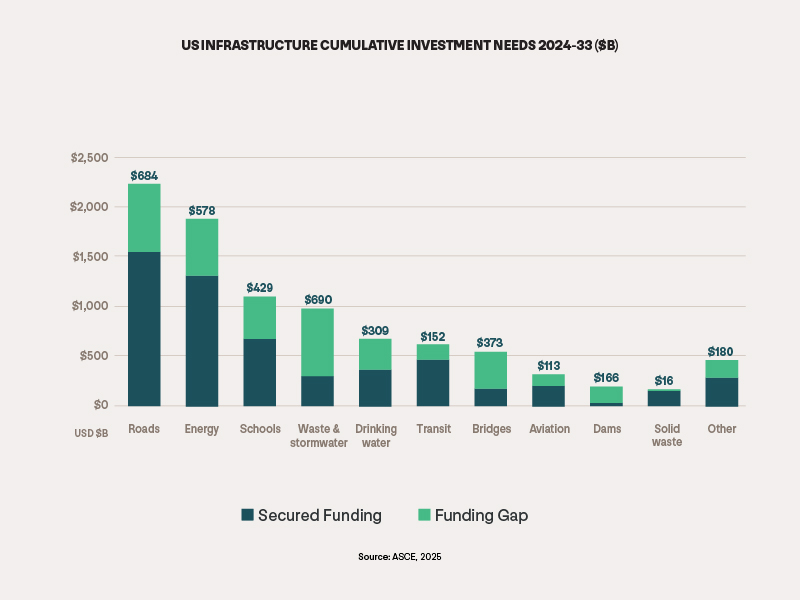
The American Society of Civil Engineers estimates that the United States faces an infrastructure funding gap of US$3.7 trillion through 2033. This shortfall spans roads, bridges, water systems, energy networks, airports and schools. The consequences of underinvestment are increasingly visible: congested roads, deteriorating bridges, ageing utilities and infrastructure that struggles to keep pace with population growth, technological change and climate risks.
This chart shows cumulative US infrastructure investment needs between 2024 and 2033. It highlights substantial funding gaps across sectors, particularly in roads, bridges, drinking water, energy and schools. Even where some funding is secured, the gap between what is committed and what is required remains large and persistent.
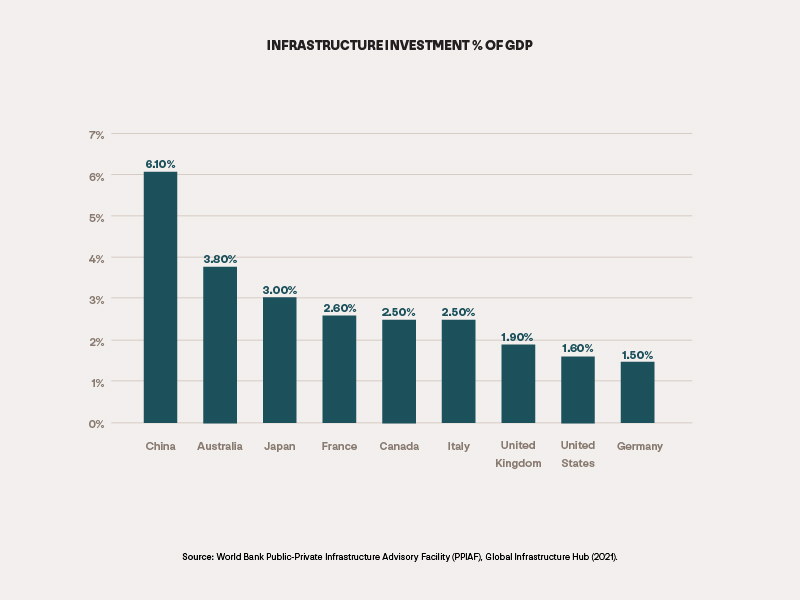
The United States invests around 1.6 per cent of GDP in infrastructure, significantly less than other G7 countries and far below China (6.1 per cent) and Australia (3.8 per cent). Decades of relatively low investment have left the US with infrastructure that lags that of global peers, along with lost opportunities to benefit from the upsides of investment, including jobs creation, economic growth and innovation in project delivery.
While recent federal programs have helped, public investment alone cannot close the gap. High public debt levels and balanced-budget requirements at the state and local level constrain borrowing capacity. As a result, we believe private investment is no longer optional; it's essential.
Pension capital is well suited to infrastructure and partnering with governments
Pension funds invest on behalf of working people and retirees, with obligations that extend decades into the future. This long-term horizon makes them natural investors in infrastructure assets, which typically generate stable, inflation-linked cash flows over long periods.
The Australian pension system, known as superannuation, represents one of the largest and fasted growing pension systems in the world.
Every week, nearly A$4.5 billion flows into Australia’s A$4.5 trillion pension system. By the mid-2030s, the system is projected to reach A$8.3 trillion, likely becoming the second largest in the world outside the US.
Pension capital has unique power. Patient, long-term superannuation capital can invest at scale through various economic cycles, fund productive assets and deliver durable long-term returns over decades for workers’ retirement savings.
Infrastructure also aligns well with pension fund needs. Revenues are often regulated or contracted, providing resilience across economic cycles and lower correlation with traditional asset classes such as equities. For governments, partnering with pension investors can also bring operational expertise, disciplined capital planning, responsible stewardship and a whole-of-life approach to asset management.
Australian pension funds have already invested US$29 billion in US infrastructure, with total investment projected to reach nearly US$67 billion by 2035. These investments include toll roads, ports, energy, utilities, data centres and logistics assets throughout the United States, demonstrating both the scale and diversity of existing pension-backed infrastructure.
Unlocking more investment: the policy agenda
Despite strong investor appetite, a lack of investable opportunities is constraining the flow of private capital into US public infrastructure like airports. State and local governments rely heavily on municipal bonds (which account for more than 90 per cent of subnational infrastructure financing) and traditional bid-build procurement. While this model has advantages, overreliance on traditional procurement can crowd out the benefits of public-private partnerships (P3s), including greater innovation and efficiency, as well as the improved user experience that comes with contractually-enforced operations & maintenance standards.
P3s and asset recycling offer effective alternative pathways but remain underutilised in the United States. To address this, we make four key recommendations.
First, governments should partner with pension capital investors to pursue asset recycling, leasing existing brownfield assets, such as roads, airports and utilities, to long-term investors and reinvesting the proceeds into new infrastructure.
Second, we propose a pilot Infrastructure Investment Incentive Grants (I3G) program, providing time-limited federal incentives to states and municipalities that successfully recycle assets and reinvest the proceeds in other infrastructure.
Third, regulatory reform could allow existing tax-exempt municipal debt to remain in place when assets enter P3 arrangements, reducing transaction costs and making projects more viable.
Finally, targeted legislative change could allow new tax-exempt debt to be used to acquire P3 concessions, further lowering financing costs and unlocking additional capital.
A generational opportunity
The United States stands at a pivotal moment. The infrastructure funding gap is large, but so too is the pool of long-term capital seeking stable investment. Pension funds - both domestic and international - have demonstrated their ability to invest responsibly, improve asset performance and deliver benefits to communities while safeguarding retirement savings.
With the right policy settings, pension capital could help revitalise America’s infrastructure, support jobs and productivity, and ensure that critical assets are fit for the demands of the decades ahead. The opportunity is generational and the cost of inaction is only growing. The time to act is now.
Read the full paper: Revitalising US Infrastructure: The Pension Capital Advantage
Learn more: https://www.ifminvestors.com/know-how