

Dan Tremblay for Fidelity Investments
The rapid expansion of artificial intelligence (AI) infrastructure is driving an unprecedented sector-specific wave of debt issuance across the investment-grade corporate bond market. These hyperscale cloud providers and data center operators are collectively expected to invest hundreds of billions of dollars over the coming decade to support AI workloads. An additional $110 billion of issuance is projected before year-end, bringing total issuance to $338 billion, compared with $17 billion of corporate bond issuance from AI-related issuers in 2024.1 These companies are also issuing in euros and other currencies to broaden their investor base, meaning they now represent many of the largest corporate issuers in the market.
While much attention has focused on the technological and economic implications of this investment cycle, less consideration has been given to its potential impact on pension asset managers who rely on corporate bond markets to value long-duration liabilities.
The link between corporate pension plans and AA-rated bonds
Corporate pension plans generally value liabilities using discount rates derived from high-quality corporate bond yields, most often based on AA-rated bonds. As AI-related issuers increasingly access debt markets to fund capital-intensive data center construction (and other related activities), they are becoming an even bigger component of the investable AA corporate bond world. This evolution raises important questions regarding sector concentration, issuer diversification, duration profile, and whether benchmark discount rates can continue to serve as a measure of corporate credit, which could potentially introduce risk between your assets and liabilities.
History provides us with a useful precedent in answering these questions. Prior to the Global Financial Crisis, financial institutions represented a significant portion of many AA corporate bond indices. When the banking sector experienced a second wave of downgrades during the European debt crisis in 2012, the composition of the AA universe changed dramatically, generating volatility and turnover. With the economic impact differing between asset managers hedging liabilities and the liability itself, pension sponsors and actuaries were forced to navigate a rapidly shifting market—one in which benchmark yields were influenced by an evolving universe of qualifying issuers. This can create unexpected tracking errors, as the liability benchmark is concentrated in AA-rated bonds, while most liability-driven investment (LDI) portfolios are diversified across a broader set of opportunities. The current AI-related spending introduces the possibility of a similar concentration dynamic, albeit in a different sector.
Actuaries value liabilities using AA-rated bonds with maturities that align with liability cash flows. When a bond is downgraded below AA, it is replaced with another AA-rated bond in the liability valuation, with no impact on the liability's value. On the other hand, if the same bond is held in the asset portfolio, its price would likely decline to reflect the lower credit rating.

Big tech is reshaping the AA-rated bond market
The composition of the AA-rated corporate bond market has significantly shifted over the past two decades. The evolution (Exhibit 1) shows that tech-related companies were largely absent from the AA corporate bond segment, with no representation among the largest debt issuers in 2005. Meanwhile, by 2015, the tech sector’s presence started to grow, with two companies making the list of the 10 largest issuers and three in the top 50. And at year-end 2025, four tech-related companies represented the top four on the list and nine held positions in the top 30. This growth occurred alongside a decline in the relative prominence of financial institutions, which historically dominated the AA market and represented the six largest debt issuers in 2005. That changed in 2015 with only one financial institution holding a top 10 rank and by 2025, financial companies only occupied six, eight, and nine, with none in the top five.
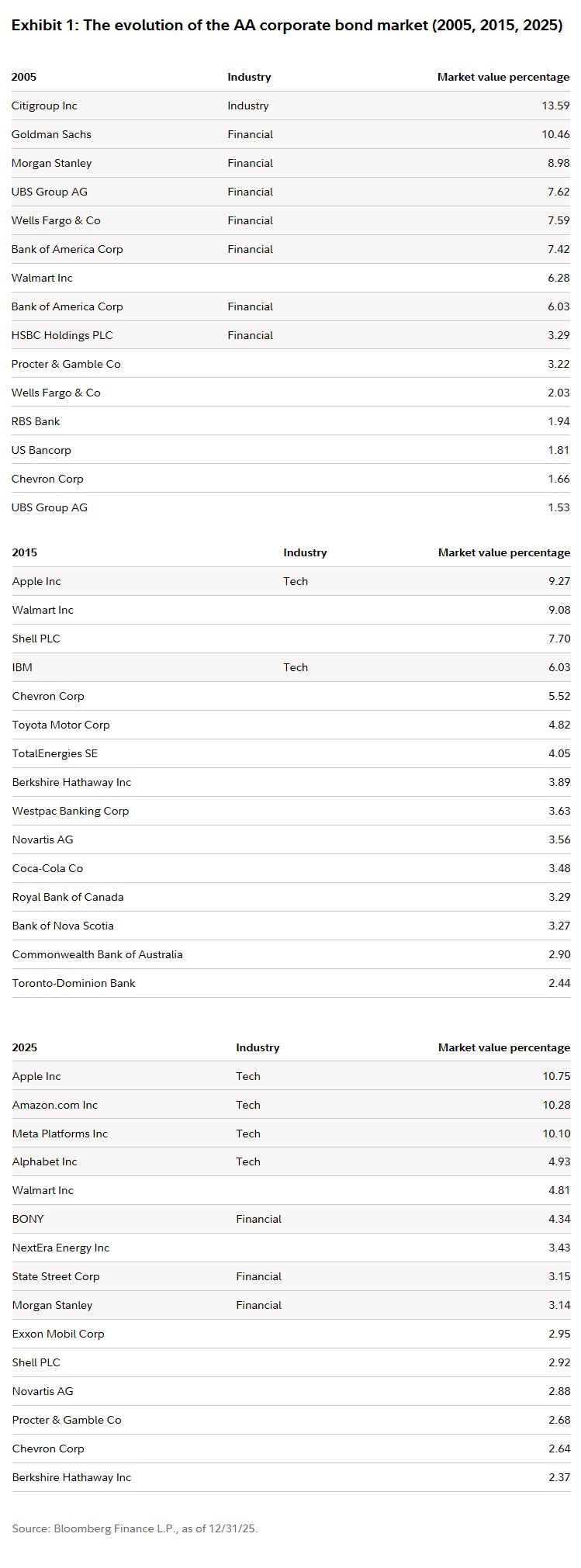
As AI debt grows, so does concentration risk
The concern is becoming less about credit quality and more about concentration risk. A discount curve is intended to reflect the borrowing costs of a broad mix of highly rated companies across many industries. However, if an increasing share of eligible AA bonds comes from companies tied to the AI ecosystem, the curve could become less diversified and more influenced by developments within a single segment of the market. In such an environment, liability valuations could become more dependent on sector-specific dynamics rather than broader corporate credit trends. The uncertainty of these investments may also impact credit and create downgrade risks.
Why this uncertainty matters for plan sponsors and their trusted advisors: It will be important to monitor the evolving composition of the underlying bond universe. In our view, these discussions could include additional diversification safeguards, issuer caps, or alternative curve construction methodologies to help ensure liability discount rates continue to reflect a broad cross-section of high-quality corporate credit, while reducing the potential for concentrated asset-liability exposures. This dynamic makes a strong case for active management and expanding the universe of securities used to hedge liabilities beyond AA-rated bonds.
Learn more about Fidelity Institutional Pension Solutions.
Please visit Fidelity’s Communities on Alternative Investments.
Daniel Tremblay, CFA, is the head of Pension Solutions within Fidelity Institutional®. In this role, he engages with internal institutional distribution and consulting partners to shape our strategy, drive the business, and focus on the innovation, development, and delivery of pension solutions and strategies.
1. Fidelity Investments, June 2026.
Unless otherwise expressly disclosed to you in writing, the information provided in this material is for educational purposes only. Any viewpoints expressed by Fidelity are not intended to be used as a primary basis for your investment decisions and are based on facts and circumstances at the point in time they are made and are not particular to you. Accordingly, nothing in this material constitutes impartial investment advice or advice in a fiduciary capacity, as defined or under the Employee Retirement Income Security Act of 1974 or the Internal Revenue Code of 1986, both as amended. Fidelity and its representatives may have a conflict of interest in the products or services mentioned in this material because they have a financial interest in the products or services and may receive compensation, directly or indirectly, in connection with the management, distribution, and/or servicing of these products or services, including Fidelity funds, certain third-party funds and products, and certain investment services. Before making any investment decisions, you should take into account all of the particular facts and circumstances of your or your client’s individual situation and reach out to an investment professional, if applicable.
The Chartered Financial Analyst (CFA®) designation is offered by the CFA Institute. To obtain the CFA charter, candidates must pass three exams demonstrating their competence, integrity, and extensive knowledge in accounting, ethical and professional standards, economics, portfolio management, and security analysis, and must also have at least 4,000 hours of qualifying work experience completed in a minimum of 36 months, among other requirements. CFA is a trademark owned by CFA Institute.
Fidelity Investments is an independent company, unaffiliated with Institutional Investor LLC. There is no form of legal partnership, agency affiliation, or similar relationship between your financial advisor and Fidelity Investments, nor is such a relationship created or implied by the information herein. Fidelity Investments is a registered service mark of FMR LLC.
Fidelity Investments® provides investment products through Fidelity Distributors Company LLC; clearing, custody, or other brokerage services through National Financial Services LLC or Fidelity Brokerage Services LLC, Members NYSE, SIPC.
Institutional asset management is provided by FIAM LLC and Fidelity Institutional Asset Management Trust Company.
1270738.2.0