Dr. Mark Shore, CME Group
At a Glance:
- Rate hikes near elections were almost always inflation-driven, such as in 1978, 1980, 1982, 2004, 2018 and 2022.
- 1982 was the only year the Fed both hiked and cut between September 1 and Election Day as it switched its target from the M1 money supply back to the Fed Funds rate.
The Federal Reserve's policy-setting Federal Open Market Committee (FOMC) raised interest rates on September 16, the first hike since July 2023 and the inaugural move under new Fed Chair Kevin Warsh, taken in response to persistently elevated inflation. The decision puts the federal funds target range at 3.75% to 4.00%.
Now all eyes turn to the Fed's next meeting where the rate decision lands on October 28 – just six days before the midterm elections on November 3.
Will the Fed adjust interest rates again so close to the elections? Using history as a guide, the Fed has established a reputation of refraining from monetary policy changes near an election date. But as September's hike shows, that reputation is a tendency, not a rule.
27 Elections, 1972–2024

This study examines 27 U.S. federal election years — both presidential and midterm — from 1972 to 2024. "Near election day" is defined as September 1 to Election Day.
Across those 27 cycles, the Fed took no action 52% of the time. When they did act, 57% of the moves were rate cuts and 43% were rate increases.
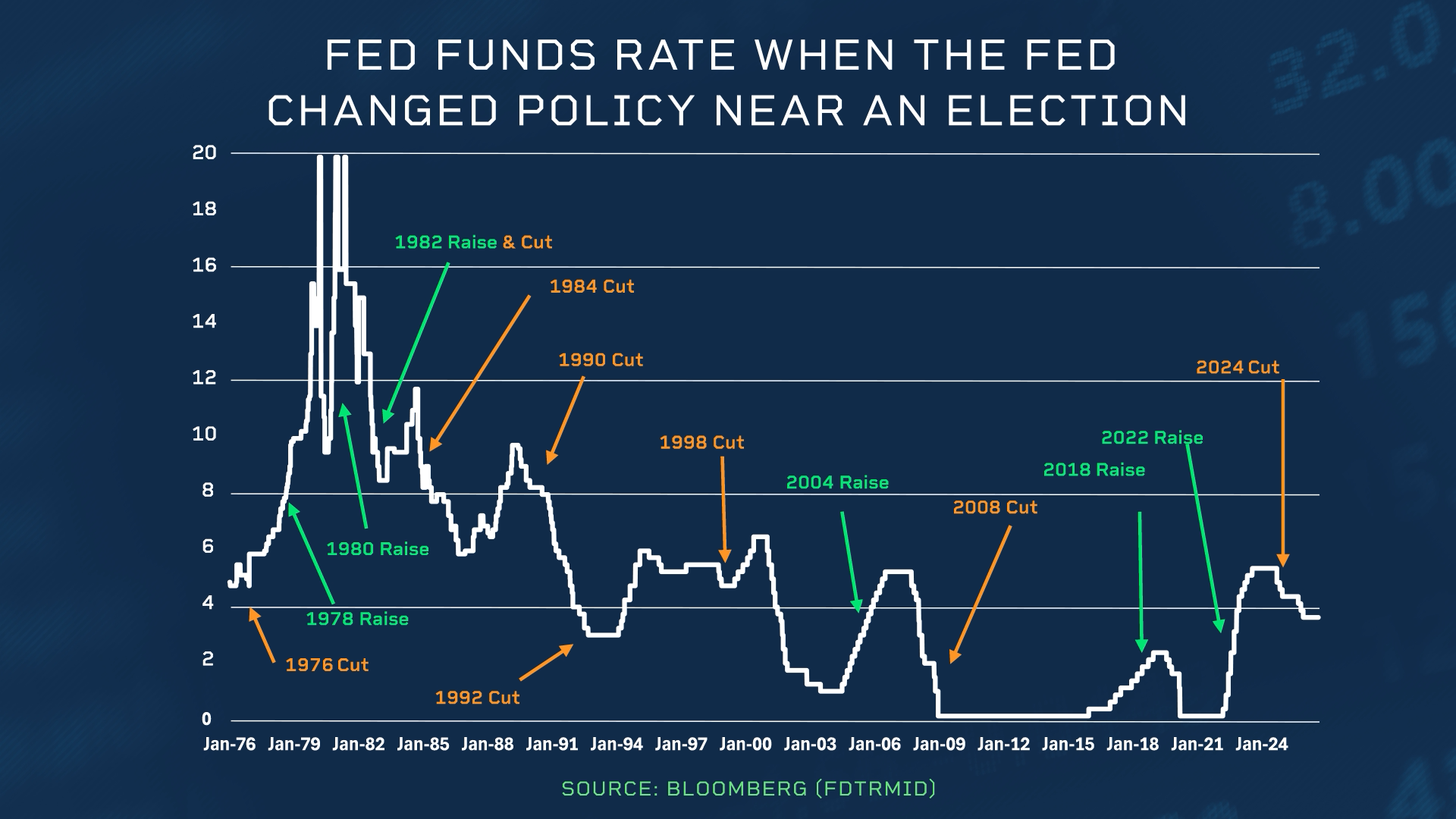
The 1982 midterm year was an outlier – the only time the Fed both raised and cut rates within the window, as the FOMC under Fed Chair Paul Volcker switched its target from the M1 money supply back to the Fed Funds rate.
Midterm Elections: The Fed Is Less Likely to Act
Midterm elections occurred 13 times between 1972 and 2024. The Fed did not act 54% of the time. When they did act, it was almost evenly split between increases and cuts. Remove the 1982 outlier and no-change rises to 62% of the time.
The four times the Fed increased rates near a midterm – 1978, 1982, 2018 and 2022 – were all tied to rising inflation. The three times it cut – 1982, 1990 and 1998 – were driven by a slowing economy or crisis: the 1990 savings and loan crisis and Iraq War energy shock, and the 1998 Russia default and Long-Term Capital Management collapse.
Presidential Years: An Even Split, With a Cut Bias
In presidential election years, the Fed was evenly split between pausing and acting. When they did act, they cut rates 71% of the time. Only two presidential years saw hikes – 1980 (fighting double-digit inflation) and 2004 (normalizing rates after the dot-com era). Five saw cuts: 1976, 1984, 1992, 2008 and 2024.
A Narrower Window: October 1 to Election Day
Narrow the window to October 1 through election day, and the Fed did not act 67% of the time. When they did act in October, 67% of the moves were cuts. Only twice did the Fed act in November just before an election – 1978 and 2022, both midterm years with rising inflation.
Bottom Line
The Fed has a reputation for not moving rates close to an election. The data backs that up, mostly. They don't act about 52% of the time across the full September-to-election window, and 67% of the time if you start counting in October. But when inflation is rising or a crisis hits, they act. And when they do, they're more likely to cut than to hike, and more likely to move in September than October.
The Fed has already raised rates in September and now all eyes turn to October 28, six days before the midterms. The historical pattern says the Fed usually holds off in October. But Warsh already broke the September mold. Will he break the October one too?
The real question is what comes after.
CME Group futures are not suitable for all investors and involve the risk of loss. Full disclaimer. Copyright © 2026 CME Group Inc.