

This environment has created a fundamental duality in investor sentiment: a cautious approach to the near term, set against a backdrop of powerful, long-term optimism. To understand how investors are navigating this shifting landscape, this report presents the findings from our latest survey of investors, which polled key decision-makers across private equity, venture capital, and other asset managers.
The results reveal a strategic pivot in response to current market dynamics. While near-term concerns are prompting investors to prioritize companies with strong financials and demonstrated resilience, the long-term outlook remains robust, fueled by a deep conviction in the sustained impact of technology—most notably, artificial intelligence (AI). Concurrently, the role of AI has evolved from a simple capability to a critical component of investment due diligence. Our findings highlight that investors now expect portfolio companies not only to possess AI capabilities for growth but also to operate within a formal AI governance framework, signaling a new premium on tech-driven risk management and strategic foresight.
With all of this as a backdrop, we find that the “certainty of uncertainty” is compelling investors to calibrate their strategies by prioritizing resilience and fundamental value, while betting decisively on the power of technology as a growth engine.
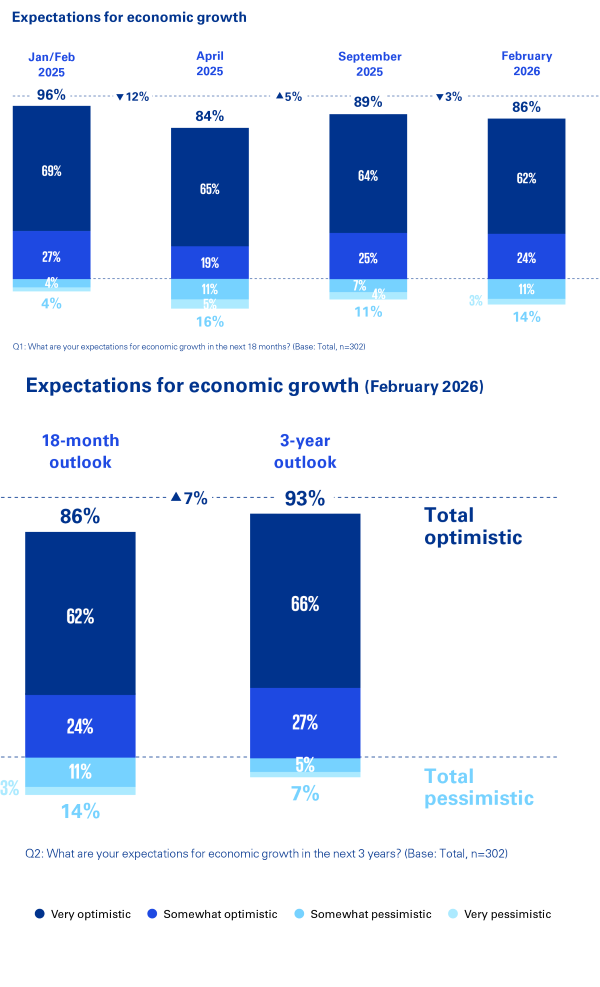
This latest edition of the KPMG Private Markets Pulse, which gathered insights from 302 institutional investors in the US, reveals a market in transition. While optimism for the next 18 months has eased since early 2025 (from 96 percent to 86 percent), confidence in the three-year outlook remains robust at 93 percent. This long-term conviction is overwhelmingly driven by a belief in the sustained impact of technological advances, specifically AI.
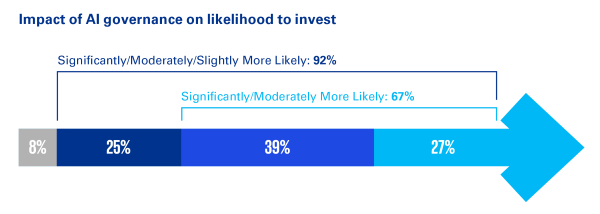
Perhaps the most significant finding is that technology, specifically AI, has become critical in investment decisions. Investors now expect portfolio companies to possess not only AI capabilities for product or service development (56 percent) and operational efficiency (53 percent) but also a formal AI governance framework. Over 90 percent of investors report that strong AI governance makes them more likely to invest, signaling a new era of tech-driven diligence.
The three-year horizon: Continued optimism
The long-term outlook is one of confidence. Looking out three years, 93 percent of investors report feeling optimistic about economic growth. This suggests a broad consensus that current headwinds, while significant, may ultimately be temporary.

What is fueling this long-term conviction? The answer lies with technology. When looking at the three-year horizon, investors identify technological advances as the most significant factor that will impact economic growth (45 percent). Immediate concerns like inflation and interest rates, which dominate the 18-month outlook, recede in importance. This long-range view underscores a belief that technology will continue to be the primary engine of economic growth.
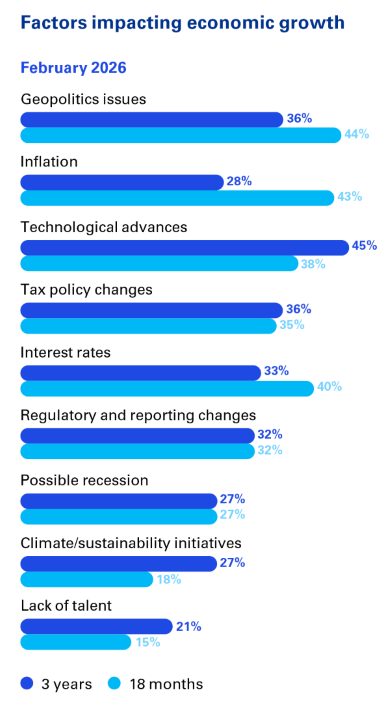
Q3: What factors do you believe will have the most significant impact on growth in the next 18 months? Please choose up to three.
Q4: What factors do you believe will have the most significant impact on growth in the next 3 years? Please choose up to three. (Base: Total, n=302)
The conservative shift in capital deployment
The current uncertainty is instilling, at least in the short term, a discipline in investment strategy. Investors are becoming more conservative and selective. This is reflected in planned capital deployment, where there has been a 12 percent decrease in the number of investors planning to deploy over $5 billion in the next 18 months.
This conservatism is not about inaction, but about a deliberate focus. When asked how market dynamics have influenced their strategy, investors prioritized:
- Companies with strong financials and demonstrated revenue growth (54 percent)
- Sectors positioned for growth in the current environment (45 percent)
- Firms with diversified and resilient supply chains (44 percent).
In an uncertain market, resilience has become a prerequisite for investment. This renewed emphasis on financial and operational health signals a clear demand for sustainable, efficient, and defensible business models—ones that can absorb shocks as risks evolve from tariffs to interest rates to geopolitical conflict.
The evolving exit landscape
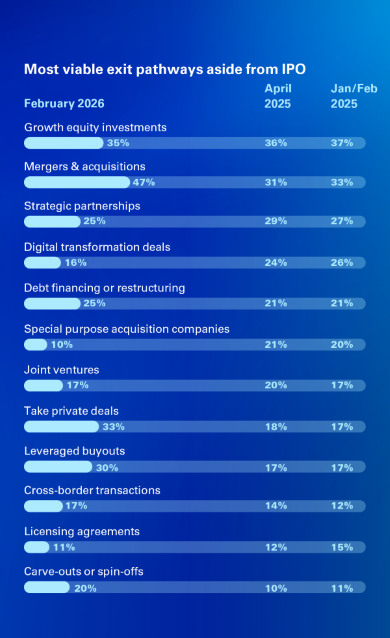
The cautious market sentiment has had a direct impact on exit strategies. Reflecting current market sentiment, a majority of investors (52 percent) anticipate an increase in initial public offering (IPO) activity over the next 18 months. This optimism is particularly strong among private equity firms—the traditional leaders in public listings—where 63 percent expect an active IPO environment.
With mergers and acquisitions solidifying its position as a viable exit pathway (cited by 47 percent of respondents), the nature of transactions is clearly shifting. Alongside a growing appetite for take-private deals and leveraged buyouts, a prominent trend we are also seeing today is the desire to execute carve-out deals. Given that these are often the most complex transactions in the market, they have become a major strategic focus. Even as 72 percent of investors remain confident in an overall increase in transaction volume, the pivot toward these intricate private transaction types is undeniable.
Fading concerns and enduring priorities
In this “age of uncertainty,” the investment landscape is defined by constant flux. While trade and tariffs remain on the radar, they are now part of a wider spectrum of “new normal” challenges, including interest rates, persistent inflation, and geopolitical tension. Investors have moved past reactive stances, instead adopting proactive mitigation strategies and building the operational readiness to thrive amid continuous change.
Despite the headwinds presented by today’s macro environment, a sense of optimism regarding growth prevails. This is due in large part to investors successfully recalibrating their short-term strategies to account for volatility. It is telling that when surveyed on complex issues like the economic impact of tariffs, investors were split almost into equal thirds—positive, negative, and neutral. This parity reflects a sophisticated, agile approach to risk, where investors are no longer deterred by uncertainty but are instead finding ways to navigate it across all fronts.
The path forward
The findings of the KPMG Private Markets Pulse crystallize the central challenge and opportunity facing investors today: The Certainty of Uncertainty. The current environment is not a temporary storm to be waited out, but a new climate to be navigated with skill and foresight.
Some or all of the services described herein may not be permissible for KPMG audit clients and their affiliates or related entities.
The information contained herein is of a general nature and is not intended to address the circumstances of any particular individual or entity. Although we endeavor to provide accurate and timely information, there can be no guarantee that such information is accurate as of the date it is received or that it will continue to be accurate in the future. No one should act upon such information without appropriate professional advice after a thorough examination of the particular situation.
© 2026 KPMG LLP, a Delaware limited liability partnership, and its subsidiaries are part of the KPMG global organization of independent member firms affiliated with KPMG International Limited, a private English company limited by guarantee. All rights reserved.
The KPMG name and logo are trademarks used under license by the independent member firms of the KPMG global organization.