
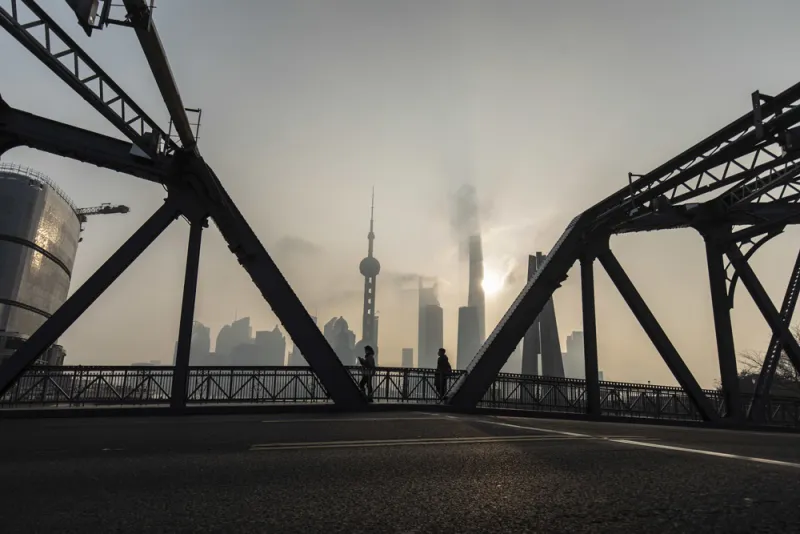
Qilai Shen/Bloomberg
Russell Lundeberg Jr. has been doing something many U.S. wealth managers still hesitate to admit to: raising his firm’s exposure to China even as relations between Washington and Beijing remain tense and unpredictable. He says the only way to invest there is to strip away the politics and treat China like any other market — one where the risk is real, but so is the payoff.
“If you remove the emotion out of China investing and use a systematic approach, it really does improve the ability to invest there,” says Lundeberg, CEO of Barrett Capital Management, a Richmond, Virginia–based registered investment advisory firm.
His method is deliberately clinical. Barrett Capital uses an AI-driven quantitative strategy that screens Chinese stocks by fundamentals such as growth, valuation, and liquidity, aiming to capture upside while avoiding the most fragile corners of the market. With clients — mostly high-net-worth individuals — Lundeberg doesn’t minimize the hazards: geopolitical shocks, regulatory threats, capital controls, and a persistent lack of transparency that can make China feel less like an emerging market than a moving target.
“But our job isn’t to avoid risk — it’s to be compensated for it,” Lundeberg explains. “And China has been extremely profitable for us.”
For much of the past decade, global investors treated China as an all-or-nothing proposition: a growth engine when politics allowed, an avoid-at-all-costs market when it didn’t.
That framing is breaking down.

Even as Washington tightens scrutiny of capital flows to China, U.S. investors are quietly returning to Chinese stocks, driving sharp rallies in public markets and growing China-focused technology funds.
The performance is hard to ignore. Shares of major Chinese technology companies tied to AI surged in 2025. Alibaba rose more than 80 percent, with Tencent and Baidu not far behind. Assets in U.S.-listed China technology ETFs ballooned by billions of dollars.
“Investors are much more interested in talking to us than they were a year or two ago,” says Kevin Carter, founder and CIO of EMQQ Global, a leading exchange-traded fund for China investments, especially in high-tech companies.
Big U.S. firms have been part of the inflows. Vanguard, BlackRock, and Fidelity increased holdings in Chinese tech leaders in 2025, according to the London Stock Exchange Group, which tracks changes in institutional ownership globally. Investor interest is at its highest level in years.
“There is no way to ignore the level of tech innovation underway in China,” says Joyce Chang, chair of global research at J.P. Morgan.
The challenge for investors is no longer whether China belongs in portfolios, but whether exposure can be structured to withstand political shocks as well as market cycles.
For asset managers and registered investment advisers, this creates a practical and fiduciary dilemma. Clients are asking about China again — not because the macro outlook there has suddenly brightened, but because Chinese electric vehicles, autonomous driving, robotics, and biotech companies are delivering performance at valuations far below those of U.S. peers.
At the same time, lawmakers in Washington and at the state level are openly questioning whether American capital should be allowed to support China’s most advanced technologies at all. President Trump muddied the story further by approving sales of Nvidia’s H200 AI chips to China, undercutting assumptions about how tightly technology containment will be enforced.
Asset managers must decide whether selective exposure can be justified amid rising regulatory scrutiny and protectionist threats. RIAs must explain to clients why their most compelling opportunities in China are also the most politically exposed.
China’s trillion-dollar annual trade surplus is intensifying protectionist calls in the U.S. and Europe, increasing the risk that investors in Chinese high-tech champions such as electric-vehicle maker BYD could become collateral damage in trade and industrial policy disputes.
Meanwhile, in China itself, the push into high-tech industries has intensified cutthroat internal competition that drives prices and innovation forward but squeezes profits, strains weaker players, and forces policymakers to step in to curb excess capacity.
The renewed interest in China has not produced a consensus. At one end of the spectrum are the enthusiasts. Matthews Asia, a San Francisco–based investment management firm often used by Lundeberg, argues that the AI-driven, high-tech opportunities in China are too tempting to turn down.
Tiffany Hsiao, a Matthews portfolio manager, insists that tension offers opportunity: “When I hear ‘geopolitical risk,’ I think: That’s great!”
At the other end are public pension funds that are exiting China investments and avoiding new ones because of rising pressure from state governments and federal agencies. The most vivid example is Texas, where the Teacher Retirement System and the Employees Retirement System are under orders from Governor Greg Abbott to divest Chinese assets, allegedly to protect Texans “from foreign adversaries, including the Chinese Communist Party.”
Most asset managers and RIAs sit in the middle. Rather than “China is back,” the message is “China is allowed — under certain conditions.” Exposure is acceptable only when it is moderate, diversified, easy to explain, and just as easy to reduce if volatility or politics flare.
But with Chinese equities outperforming the S&P 500 and most other developed markets, voluntarily opting out of China investing isn’t an easy answer anymore. It can feel less like prudence and more like an active bet against a market that’s moving upward for rational reasons.
“Despite external noise, 2025’s market behavior highlights a clear message: Fundamentals — not geopolitics — remain the dominant driver of China’s equity performance,” writes Wenli Zheng, a portfolio manager at T. Rowe Price Advisory Services, in his global market outlook report for 2026.
That’s the line many advisers want to believe. But as recent history shows, geopolitics still has the power to shut the trade down.
It’s easy to forget how normal China exposure once seemed.
During the heyday of foreign investment in China — from the early 1990s to the 2010s — global capital poured in. The pitch was simple: a rising middle class, a giant consumer market, and a technology sector that looked like a parallel Silicon Valley.
But then the story fell apart. China’s property market began to unravel. Consumer spending stagnated. Corporate and government debt ballooned. And Beijing launched regulatory crackdowns that reminded investors who was in charge. The most symbolic moment came in 2020, when Jack Ma’s Ant Group IPO was halted and Alibaba, the huge high-tech firm Ma founded, became a political target. The message to private enterprise was unmistakable. China’s tech giants could thrive only if they were aligned with the government’s priorities.
That was the turning point for many Western investors. Private capital pulled back first. Venture and private equity flows collapsed. The pipeline of U.S. money into Chinese start-ups shrank dramatically. Investors worried about sanctions. They worried about exits. They worried about being caught in a new Cold War with real compliance consequences.
The expectation heading into Trump’s second presidency was that the hard line would only harden. For a while, the market traded as if decoupling was inevitable.
And then the tide turned again.
The Trump administration backed down from imposing heavy tariffs on China after Beijing threatened to suspend exports of rare minerals critical to U.S. manufacturers, particularly the auto industry.
As enthusiasm for artificial intelligence pushed U.S. tech stocks to ever-higher valuations, investors began to worry about an AI bubble. Then DeepSeek appeared, jolting assumptions about who could compete in advanced AI and prompting a fresh look at China’s technology sector.
China’s tech giants, shunned for political and regulatory reasons over the past five years, have been trading at low multiples despite generating substantial cash flow. Unlike their U.S. counterparts, they had abundant, inexpensive electricity, thanks to nearly five decades of huge state investments in fossil fuel and nuclear plant generation and, more recently, solar and wind power. This made China look less like a risky outlier and more like a market full of underpriced, profitable high-tech companies.
AI has become a U.S.-China race. “And each side has inputs that the other needs,” notes J.P. Morgan’s Chang. “China’s advantage is its ability to scale very cheaply, while the U.S. leads in creating the models themselves.”
Renewed investment in China benefits from other tailwinds as well. The dollar has weakened. Investors are again seeking diversification. And China, which contributes about 30 percent of global GDP growth, is the world’s second-biggest economy.
Still, it is not a market for indiscriminate buying.
“Be open-minded about and gain exposure to rising Chinese disruptors, who are likely to survive U.S.-China competition and global protectionism,” advises Johnny Yu, a Wellington Management macro strategist.
All those factors point investors toward a set of high-tech industries where China’s advantages are most visible: electric vehicles, autonomous driving, robotics, and biotech.
On the streets of Shenzhen, rows of brand-new BYD cars are rolling out of factories faster than dealerships can sell them.
China’s BYD has become the world’s leading EV manufacturer by volume thanks to a combination of vertical integration, tight cost control, and relentless expansion across price points — moving well beyond niche or luxury models to compete simultaneously at the low, middle, and high ends of the market.
This rise underscores a central reality of China’s EV boom: BYD’s biggest rival isn’t Tesla. The fiercest competitors are other Chinese manufacturers locked in an unforgiving price war at home. The battlefield is crowded, fast-moving, and brutal — and that is precisely what makes BYD’s dominance so revealing. BYD is winning not by occupying a protected niche, but by surviving prolonged price compression and still making money.
Tesla remains the global standard-bearer for EV software and branding, but its position looks more fragile. Sales growth has slowed, and profit margins have narrowed. Its valuation — roughly 200 times forward earnings — rests heavily on promises by founder Elon Musk that car-making is part of a grander scheme encompassing robotics and autonomous driving. Like other U.S. EV producers, Tesla faces headwinds from its deep reliance on China-centered battery and supply chains.
BYD, by contrast, trades closer to 15 times forward earnings. For investors, the company illustrates how China can win through manufacturing scale and integration even without leading on every technological frontier.
Auto strategist Michael Dunne, CEO of Dunne Insights, describes China as an “irresistible force” in the global auto industry. Chinese EV makers, he says, can produce vehicles at a roughly 25 percent lower cost than competitors while maintaining solid quality. With capacity sufficient to supply as much as half of global demand, they are under pressure to expand abroad as price wars erode profits at home.
On a recent evening in Wuhan, commuters climbed into a taxi with no driver, scanned a QR code, and watched the steering wheel turn itself as the car merged into traffic. It was just another routine ride in Baidu’s Apollo Go robotaxi network, where autonomous cars have become mundane enough to inspire impatience when they linger too cautiously at a light.
Nowhere is China’s technological progress more visible — or more unsettling for U.S. competitors — than in autonomous driving.
The first advantage is cost. America’s robotaxi leader, Alphabet’s Waymo, spends between $130,000 and $200,000 per vehicle, packing its cars with high-end sensors and massive onboard computing power. By contrast, HSBC estimates the average cost of a Chinese robotaxi at roughly $40,000.
China’s enormous domestic market and relentless competition have pushed vehicle prices down. The widespread availability of basic driver assistance systems has boosted scale and reduced costs for key components, like lidar, the laser-based sensors used to create three-dimensional maps of a vehicle’s surroundings.
Those advantages show up most clearly in deployment. Apollo Go’s robotaxi service has expanded across multiple Chinese cities and now logs hundreds of thousands of rides a week — approaching the scale of Waymo, which pioneered commercial robotaxis in the U.S.
Waymo remains the benchmark for safety validation and autonomy depth. Its systems are designed to operate reliably in unpredictable conditions and to withstand intense regulatory and legal scrutiny. But Apollo Go shows how China’s operating environment — fewer regulatory choke points, faster permitting, and cities that generate massive data flows — can accelerate learning and expansion even if the underlying technology still needs refining.
For investors, the comparison highlights a central trade-off. In the U.S., autonomous driving is treated like aviation: Prove it’s safe, then expand carefully. In China, it is viewed more like consumer technology: Ship early, upgrade quickly, expand aggressively, and learn from scale.
Both approaches carry risks. The U.S. could move too slowly and cede commercial leadership. China could go too fast, with accidents or failures that could trigger abrupt regulatory reversals.
Recent visitors to China may have noticed traffic cops who turn out to be robots — dressed in regulation uniforms and mirror shades, each complete with a wig tucked into a meter maid cap. It’s a clever bit of stagecraft that normalizes a far bigger shift: a future in which taking instructions from humanoid machines no longer feels radical.
In robotics, China’s advantages are speed, cost, and manufacturing scale. The nation leads the world with more than two million industrial robots in operation — nearly four times the total deployed in the United States. That dominance reflects a familiar pattern: dense supply chains, aggressive pricing, and an ability to turn engineering advances into mass-produced hardware quickly.
Unitree Robotics embodies that approach. The company has brought AI-driven humanoid robots to market at prices that dramatically undercut Western competitors, emphasizing rapid product cycles and continual refinement rather than technical perfection. The goal is not to build the most sophisticated robot in the lab, but to put capable machines into customers’ hands and improve them through use.
In consumer robotics, China’s edge is even clearer. Picea’s acquisition of the assets of bankrupt U.S. pioneer iRobot, creator of the robot vacuum cleaner, marked a symbolic turning point. A category invented and popularized by an American company is now dominated by Chinese manufacturers that excel at cost control, frequent product updates, and global distribution. What began as innovation has become an industrial commodity — and China is winning this phase.
The U.S., however, still leads where reliability and autonomy matter most. American firms, such as Figure AI and Agility Robotics, dominate in both frontier autonomy — systems that allow machines to make complex decisions in unpredictable environments with minimal human input — and enterprise-grade reliability, technology robust enough to operate safely day after day in factories, warehouses, and other mission-critical settings.
In a sprawling Guangzhou lab, where researchers once chased copies of Western drugs, BeOne Medicines pushed an experimental cancer drug from discovery to large human trials, regulatory approval, and distribution. The company did this in a fraction of the time and at a far lower cost than it typically takes Western drug giants.
China’s pharmaceuticals and biotech sector is no longer just a source of cheap generics. It is producing globally competitive drugs — and U.S. drugmakers are responding with their checkbooks.
During the first half of 2025, U.S. pharma companies signed 14 deals worth $18.3 billion to license medicines from Chinese firms, according to GlobalData, a London-based data analytics group. That compares with just two deals worth less than $300 million in the first half of 2024.
And the timing is not accidental. Policy pressure in Washington is squeezing profits for large U.S. drugmakers and dampening incentives to fund expensive early-stage research at home. Faced with looming patent expirations and rising political scrutiny, American firms are increasingly shopping for innovation abroad — and China is where the pipeline is deepest and cheapest.
According to Brian Abrahams, head of global health care research at RBC Capital Markets, that’s “a growing trend worth watching, which we haven’t seen in the past.” He estimates that large biopharma companies have more than $350 billion in global annual sales at risk over the next decade as blockbuster drugs lose patent protection.
What explains the rapid rise of China’s drugmakers? Speed, scale, and cost. Chinese firms can move a drug from discovery to first-in-human trials in roughly half the global industry average time. Clinical trials themselves — the slowest and most expensive phase of drug development — also proceed faster, helped by a vast patient pool and a dense network of trial centers that streamline enrollment.
That advantage is no longer theoretical. BeOne Medicines, formerly BeiGene, has built a global oncology franchise with multibillion-dollar revenues, large international trials, and Federal Drug Administration–approved drugs competing directly with therapies from Big Pharma companies like Pfizer.
For investors, the contrast is stark. Pfizer offers scale, regulatory familiarity, and geopolitical neutrality. BeOne offers faster growth, lower valuations, and access to China’s rapidly expanding clinical trial ecosystem. It has become a test case for whether a Chinese drugmaker can credibly join the ranks of Big Pharma while remaining investable for Western capital.
Even as China’s high-tech sectors regain investor attention, Beijing is wrestling with a problem of its own making: “involution.” The term — now part of China’s official economic vocabulary — describes a system in which competition intensifies but returns diminish. Companies work harder, invest more, and cut prices aggressively, yet profits stagnate or fall.
In practical terms, involution shows up as brutal price wars, duplicated investments, and thinning margins across industries Beijing celebrates as national champions.
Electric vehicles are the clearest example. China has world-leading EV capacity, but too many manufacturers chasing the same buyers have driven prices down to levels that strain even efficient producers. Robotics, solar panels, and consumer tech face similar pressures, as firms race to scale while struggling to earn sustainable returns.
Chinese policymakers have begun to acknowledge the problem openly. Officials now warn against “disorderly competition” and urge companies to focus on innovation rather than relentless price-cutting. Regulators have floated measures to consolidate industries, limit excess capacity, and nudge firms toward profitability over sheer volume. The message is clear: Growth at any cost is no longer the goal.
For investors, involution cuts both ways. On the positive side, it accelerates innovation, forces cost discipline, and weeds out weaker players — conditions that can leave dominant firms stronger. On the negative side, it caps margins, shortens product cycles, increases the risk of government regulation, and adds yet another layer of risk for investors.
No matter, insists Barrett Capital’s Lundeberg, who sticks to the fundamentals of Chinese equities.
“The question isn’t whether the risks exist — it’s whether they’re priced in, and how to spread exposure so no single risk can dominate the portfolio,” he says.