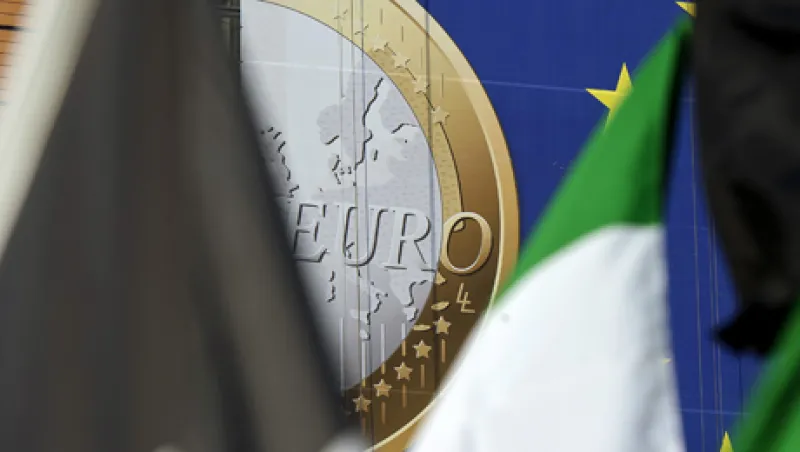
The European Union’s awkward compromise agreement on the single supervisory mechanism (SSM) on December 13 keeps the European Commission’s proposals for a banking union on track. This is just as well since the commission had set itself an end-of-year deadline, and the mechanism is a core part of the euro zone’s efforts to recapitalize its banks and resolve its debt crisis. But it won’t be the final word on the banking union or even on the SSM. Further rows about banking supervision are all but inevitable, as are tougher battles over a Europe-wide deposit guarantee scheme and a resolution fund for winding down failed banks, the other two projected pillars of the banking union.
The European Council meeting in Brussels agreed that “the SSM will be composed of the European Central Bank and of national supervisory authorities,” conceding in that sentence that the singular character of the supervisory mechanism is questionable. The ECB will, from March 2014 at the earliest, directly supervise euro zone banks’ holding assets of €30 billion ($39.5 billion) or more, or less if they represent 20 percent of national GDP. This is likely to mean that only about 150 out of 6,000 EU banks will see a change in the way they are supervised. The Council also agreed on a separation of the ECB’s role in administering monetary policy with the creation of a dedicated supervisory board within the central bank.
This is a victory, for the time being, for Germany and its finance minister Wolfgang Schauble, who publicly said at the EU’s economic and financial affairs council (ECOFIN) earlier in the month that “nobody believes that any European institution would be capable of supervising 6,000 banks in Europe.” Both the Commission and the ECB want a greater role for the latter, although Mario Draghi, the ECB’s president, has always said that day-to-day supervision would be in the hands of national authorities.
German officials argue there is no fundamental disagreement on the SSM. Schauble had already agreed in principle to the SSM in June, so he was arguing on grounds of “practicality,” says a source close to Schauble at the German federal finance ministry in Berlin. “In time, if the ECB does a good job, its role can be extended,” he says.
But this extension of the ECB’s role won’t be straightforward, since the source also hints at deeper reservations about the potential role of the ECB. “It’s a waste of the ECB’s resources for it to look after smaller banks that never ran into trouble,” he says.
Schauble is being intensively lobbied by Germany’s numerous smaller banks, who are hostile to the very idea of the SSM. Gerhard Hofmann, a member of the board of the Berlin-based BVR, which represents 1,100 cooperative banks in Germany, tells Institutional Investor, “it remains to be seen whether the SSM as a function of the ECB will be a sustainable or rather a transitory regime.”
And the SSM is just the easy part of the banking union. Sharing financial resources is a more sensitive issue. Schauble publicly told his fellow EU finance ministers on December 12 that they shouldn’t rush to inject money from the €500 billion European Stability Mechanism into struggling banks. “Again and again we have created expectations we cannot fulfill and that is very dangerous. We should be modest.”
This doesn’t bode well for the commission’s ambitions to introduce a common bank deposit guarantee scheme and a European resolution fund, for which proposals have yet to be put forward.
For the moment, the commission and the ECB are simply relieved that an agreement was reached on time. “The ECB will launch the preparations so that the SSM can be established within the timeline foreseen by the ECOFIN,” said Draghi in a statement on December 13. Michel Barnier, the Internal Market Commissioner and the official charged with driving through banking union legislation, welcomed “a common approach on a fundamental element of financial stability in Europe,” he said in a statement.