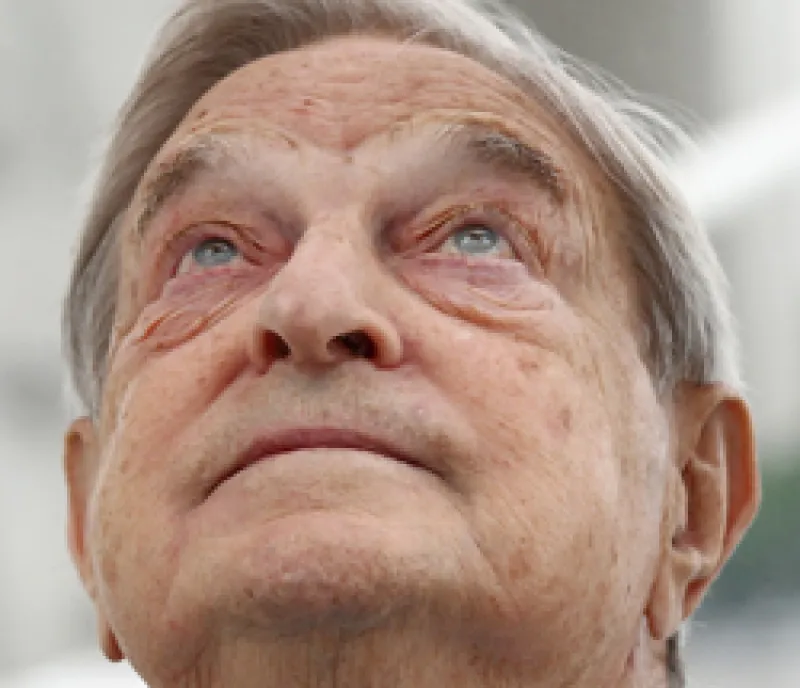
George Soros’ announcement Wednesday that he is returning outside money from his hedge fund and will continue to operate as a family office is yet another reminder of how hard and clumsy it is for a billionaire hedge fund manager to retire.
Except on rare occasions, most successful hedge fund managers rarely seem to call it quits on a high note. Part of the reason is they seem to have trouble retiring in general.
In the case of Soros, if the octogenarian stuck around longer, he may have somewhat tarnished his stellar image. While he has enjoyed a 20 percent annualized return over the several decades he has run his multi-strat Quantum funds, this year he was down 6 percent through June after eking out just a 2.63 percent gain last year, according to knowledgeable sources. And at a conference several months ago, Soros seemed confused by the current market environment, reportedly stating: “I find the current [market] situation much more baffling and much less predictable than I did at the time of the height of the financial crisis.”
However, the story ended quite differently for Tiger Management’s Julian Robertson. During the 1990s, he along with Soros and Michael Steinhardt were the hedge fund industry’s standard bearers who helped put the asset class on the Wall Street map and their huge personal financial success attracted a generation of billionaire wannabes to the business, for better or worse. The firm grew from $700 million at the beginning of the decade to $12 billion at the midway point and to a peak of $26 billion by 1998.
However, as the tech and internet bubble inflated in the late 1990s, Robertson stubbornly refused to capitulate and continued shorting many of the soaring stocks, causing him to lose money. When many of his investors, whom Robertson had made rich, sought to redeem their holdings, Robertson pulled the plug on his funds around the time the global markets peaked in March 2000. But only after he had dropped 40 percent between 1997 and 2000.
By then he had about $6.5 billion under management and investors who got in during the later years actually lost money.

Today he is enjoying a second, successful life seeding fledgling managers. And he is launching a fund of seeds called the Accelerator. But his final years running his own hedge funds will always tarnish his reputation.
Pequot Capital’s Art Samberg was also one of those larger-than-life hedge fund managers during the 1990s. But unlike Robertson, he and his partner, Dan Benton, thrived during the tech/internet bubble.
In 1999, Samberg’s Health Care fund racked up a 157.1 percent return, his Technology fund finished up more than 102 percent, and two other large funds climbed 60 percent and 46 percent. He found himself running one of the largest hedge fund firms, with roughly $15 billion under management. Benton was legendary for his better than 60 percent annualized returns running Pequot Technology. By 2000, Pequot was managing $15 billion.
In September 2001, Samberg and Benton officially went their separate ways — each taking roughly $7.5 billion assets — with Samberg keeping the Pequot name and Benton creating a new firm, Andor Capital. However, flying solo Samberg never regained his old cache. And then his professional world came crashing down amid a Securities and Exchange Commission probe into possible insider trading at the firm.
In May 2010, without admitting or denying the allegations in the SEC’s complaint, Pequot and Samberg agreed to pay nearly $28 million stemming from insider trading in the stock of Microsoft. Pequot and Samberg also agreed to an order censuring Pequot and, subject to a limited carve-out, barring Samberg from association with an investment adviser.
Several one-time high-flying managers faded from the scene after a rapid rise in performance, fortune and fame, only to come crashing down from the 2008 financial meltdown.
In the middle part of the last decade, Timothy Barakett’s Atticus Capital was one of the top performers. In 2005, 2006 and 2007, his Atticus Global fund was up 22 percent, 36.5 percent, and 25.4 percent, respectively, while Atticus European, run by David Slager, was up 62 percent, 44.5 percent and 28 percent, respectively.
At the end of the third quarter of 2008, shortly after the markets went into a freefall following the bankruptcy of Lehman, Atticus’ European fund was down 42.5 percent for the year while the Global fund lost 27.2 percent. Redemptions came pouring in and the firm’s survival was rumored to be in doubt. The two funds finished the year down 40 percent and 25 percent, respectively, thus holding their own in the fourth quarter.
However, in August 2009 Barakett — a one-time star for the Harvard hockey team — shut down Atticus, saying in a letter to investors he planned to spend more time with family, pursue philanthropic interests and establish a family office to manage his own capital and charitable foundation.
Then there is Jeffrey Gendell, founder of Tontine Associates who racked up triple-digit returns in 2003 and 2005, before crashing in 2008 when most of his funds lost between 65 percent and 75 percent and one of his funds — Tontine Partners LP fund — reportedly lost 91.5 percent.
Gendell blamed the combination of falling commodity prices, massive anticipated hedge fund redemptions and the seizing up of the credit markets for his nightmare year in 2008, which he described as “once in 13 years” for his funds in a letter to investors in October 2008. However, writings in his client letters over that year indicated he was also guilty of not grasping the magnitude of the crisis at the major financial institutions during the summer and wrongly betting that the market had bottomed in late September after Lehman filed for bankruptcy.
He also was hurt by large holdings in small, illiquid stocks in which he took large stakes — Exide Technologies, Integrated Electrical Services and Innospec.
In any case, Gendell, who for many years was ranked on AR’s annual list of the 25 highest earning hedge fund managers, faced a slew of redemptions from angry, outraged investors. So, he decided to close down two funds. But, he threw up gates so he could take his time returning the money.
Duquesne Capital’s Stanley Druckenmiller, who during the 1990s was also Soros’ chief trader, seemed to go out on top last year when he announced his retirement. Even so, his decision seemed to be abrupt and unchoreographed.
Sure, he generated a 30 percent annualized return over 30 years, although in each of the past three years he only posted single-digit net returns. It seems, according to published reports, that Druckenmiller decided to retire after a friend was incredulous that Druckenmiller declined a golfing invitation because he had to work. “Are you crazy?” the friend told Druckenmiller, according to Bloomberg. “You’ve been doing this for 30 years. You are a billionaire. You can’t take a couple of days off to play golf?”
Now, as a generation of legendary hedge fund managers move through their 50s and 60s, investor eyes are focused sharply for signs that they may be losing interest.
Already Caxton Associates’ Bruce Kovner is dialing back from day-to-day running of the firm, and with mixed success.
Meanwhile, investors are wondering when Tudor Capital’s Paul Tudor Jones II, Moore Capital’s Louis Bacon, Perry Capital’s Richard Perry, Kingdon Capital’s Mark Kingdon and Appaloosa Capital’s David Tepper will lose interest and start to wind down.
If history is any indication, many of them will not leave on a high note.