
Greece’s debt troubles have captured the world’s attention, and headlines, in recent months. Even after the country’s unprecedented bailout by the European Union and the International Monetary Fund, angry protests in Athens raise the question of whether Greeks will accept years of painful austerity rather than default on their obligations. The crisis has split Europe’s political leaders and prompted German politicians to lash out at speculators and impose curbs on short-selling. Suddenly, the future of the euro seems in doubt, and the fallout in financial markets risks tipping Western economies back into recession.
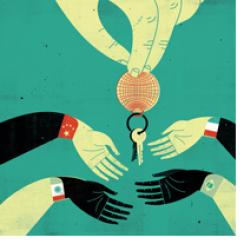
China and Greece may be extreme examples, but their differing fortunes reflect a much broader shift in the balance of economic power in favor of the world’s emerging-markets countries. The shift has been under way for more than a decade, but the financial crisis of the past two and a half years has put it in stark relief. Emerging-markets economies, led by China, India and Brazil and including much of Southeast Asia and Latin America, have rebounded quickly from the global slump that followed the collapse of Lehman Brothers Holdings in September 2008. The IMF forecasts that emerging and developing economies will grow by 6.3 percent this year, with China leading the pace at a 10 percent clip, India following closely at 8.8 percent and Brazil, South Korea and much of Southeast Asia expanding by 5 to 5.5 percent. By contrast, the major developed economies face a much more sluggish outlook as the damage left by the financial crisis and burgeoning government debts cloud recovery prospects. The U.S. is likely to grow by 3.1 percent this year — a modest rebound by historical standards — the euro area by just 1.0 percent and Japan by 1.9 percent.
“It’s the recovery of the investment process in the developing world that is the most important determinant in the global economy,” says Hans Timmer, director of the World Bank’s Development Prospects Group in Washington. “Countries like China and India are leading the global economy.”
Developing nations have often grown faster than the advanced economies, but the scale and pace of the change taking place today are unprecedented. Countries like Japan and South Korea have industrialized rapidly in the past, lifting tens of millions of people from poverty to first-world living standards. Today the process involves dozens of countries and billions of people across Asia, Latin America, the Middle East, Eastern Europe and even parts of Africa.
“We are going through the most dramatic transformation of the world economy ever,” says Kemal Dervi¸s, a former Turkish Finance minister who heads the Global Economy and Development program at the Brookings Institute in Washington.
For investors, this transformation presents opportunities and risks. Money has been pouring into the emerging markets in recent years, and strong performance there can help offset weaker results at home. But most Western institutions still lag well behind economic reality, having less than 10 percent of their assets in developing markets. Increasing their exposure in markets where they lack experience, and where many valuations appear frothy, will not be easy or risk-free.
For policymakers, the challenges are even greater. The rise of new powers could support the global economy at a time when the U.S., Europe and Japan are struggling with massive debts, and help foster sustainable, more balanced growth. But doing so will require a greater degree of coordination among major countries than they have ever managed before, and at a time when protectionist forces are growing louder. The Group of 20 nations agreed quickly on the need for stimulus in late 2008, when the world faced the threat of depression, but this relatively new forum will find it difficult to maintain a consensus as the fortunes of its members diverge.
“There is no constituency for the global economy in any country,” says Raghuram Rajan, a finance professor at the University of Chicago’s Booth School of Business and a former IMF chief economist. “Domestic economics and politics always trump the global situation.”
Emerging-markets economies have been ascendant since the early 1990s. At the time, China was accelerating market-oriented reforms under then–vice premier Zhu Rongji to build the regime’s popular support following the Tiananmen Square crackdown. India was starting to dismantle its so-called license raj protectionist system and open up to global trade under then–Finance minister Manmohan Singh. And the countries of Central and Eastern Europe were abandoning central planning for the rigors of capitalism. By the early part of this decade, most of Latin America and many parts of Africa had adopted the credo of reform that included privatization, deregulation and independent, inflation-fighting central banks.
There was no shortage of crises along the way, from Mexico’s banking panic in 1994–’95 to the Asian financial crisis two years later to the IMF rescue packages for Brazil and Turkey in 2002. Those crises were the teething pains of entry to the global economy and exposure to volatile flows of international capital. The bigger picture, however, showed a striking decoupling of the growth rates of emerging and advanced economies.
Emerging economies took a big hit from the collapse in global trade after Lehman’s failure, briefly reviving a debate on whether these countries had truly decoupled from the West. But these markets have bounced back much faster and stronger than the developed economies. The lesson, says Timmer, is that although globalization of trade and financial markets has synchronized economic cycles — economies around the world are more likely to move up and down in tandem — emerging markets continue to outpace the developed countries and are likely to do so by a wide margin for at least another 15 to 20 years.
Consider the scale of the change. From 2000 to 2009 the U.S. was the biggest contributor to global growth, boosting its output by some $4.3 trillion, according to data from the IMF and Goldman Sachs. China was second at just under $3.5 trillion, followed by Germany, France and Italy. But in the current decade, China is expected to contribute more than $7 trillion to global growth, more than twice as much as the U.S.’s $3 trillion. Seven of the top ten contributors to global growth this decade will be emerging-markets or newly industrialized countries: China, India, Russia, Brazil, Mexico, South Korea and Turkey. Besides the U.S., only two other developed powers will be in that group: Japan and the U.K.
Within the past two years, China has overtaken Japan as the world’s second-largest economy, Germany as the world’s largest exporter and the U.S. as the world’s largest automobile market. Goldman Sachs’ O’Neill, who coined the term “BRIC” to highlight the growth of the leading emerging powers, predicts that the collective output of Brazil, Russia, India and China will surpass that of the U.S. by 2018. By 2027, China itself will overtake the U.S.
In addition to underscoring the rise of emerging economies, the crisis has highlighted the fact that economic and political risks can be as great in developed economies as in the developing world. Arminio Fraga, who helped put Brazil on the path to low inflation as head of the country’s central bank from 1999 to 2002 and who now heads the $5.8 billion-in-assets hedge fund manager Gávea Investimentos, says he and others in the emerging markets were shocked to see a crisis of such magnitude emanate from the U.S. “We were always used to looking at this in our countries, but not at the core of the global financial system,” he says.
“Who could’ve imagined that GM, Citi and AIG had to be bailed out? That we, the developed world, would mess up? That they, the emerging markets, had better economic policies and better regulatory structures than we did?” says Antoine van Agtmael, who coined the term “emerging markets” as a World Bank official in the early 1980s. Today he chairs Emerging Markets Management, a $12.8 billion fund manager in Arlington, Virginia. “The risks here are becoming larger, and the risks there are becoming lower.”
The strong performance of emerging-markets countries is welcome at a time when the global economy badly needs sources of growth. But the key question is, what kind of growth? The deep recession in the U.S. and the need to work off the country’s huge debt overhang should rule out a return to the previous practice, whereby China and other emerging-markets nations funneled their reserves to the U.S. so American consumers could carry on shopping. Emerging countries need to foster domestic consumption and rely less on exports, and the U.S. has to save and produce more and spend less.
So far, however, there are few signs of that happening. China’s trade surplus has narrowed sharply in recent months, with import growth far outpacing exports, but the country’s surplus with the U.S. — a record $227 billion last year — has failed to contract. Moreover, Europe’s debt crisis threatens to exacerbate trade tensions. A debt-plagued Europe forced to undergo austerity measures will be looking to boost its exports rather than buy more U.S. goods. And the weakness of the euro is likely to make Beijing reluctant to allow the renminbi to appreciate, as Washington is demanding.
Bridging these differences will be critical for the global economy. After the outbreak of the financial crisis in 2007, the U.S. and its allies abandoned the old Group of Seven framework in favor of the G-20. The expanded organization was a bold symbol of the new world order, giving rising powers like Brazil, China, India and Turkey seats at the global policy table. The G-20 did help forge a quick consensus on the need for stimulus back in 2008. And at their summit meeting in Pittsburgh last September, G-20 leaders called for a mutual assessment program in which countries are to submit their economic policies to a collective review to determine if they will contribute to more-durable and more-balanced global growth.
The IMF, which is leading the review process and plans to deliver conclusions at the G-20 summit in Seoul in November, is “quite hopeful and quite optimistic there will be a serious outcome,” says John Lipsky, the Fund’s first deputy managing director. Many observers are skeptical, though. Tim Adams, managing director of the Lindsey Group, a Washington consulting firm, and a former U.S. Treasury undersecretary for international affairs, says that, if anything, international policy coordination shows signs of breaking down. He points to the virtual demise of the Doha round of global trade negotiations and to the failure of the global talks on climate change in Copenhagen last December.
Adams worries about a growing divergence between economic power, which is shared more widely today, and military power, which remains concentrated in U.S. hands. “We’ve had a Pax Americana in the postwar era. There has been an extraordinarily long period of peace and prosperity,” he notes, but “greater diffusion of power creates greater complexity, greater possibility for things to go awry.”
The shift of economic power from the West to emerging-markets countries is likely to remain turbulent. It would be rash, though, to project recent trends into the indefinite future. Buyers of Tokyo real estate circa 1989 or of the 1999 book Dow 36,000 know the folly of taking optimism to the extreme. The BRICs and other developing economies face challenges of their own and are not guaranteed to inherit the earth, just as the U.S. and Europe are not destined to slide into irrelevance. As Fraga points out: “The mature economies are developed for a reason. They have done well over a number of years.”
In short, the new world order doesn’t allow anyone to become complacent. “What we’ve come to realize is, there’s no end point” to development, says Rajan. “You have to be continuously aware of the fragility of your economy.”
That’s true now more than ever.