
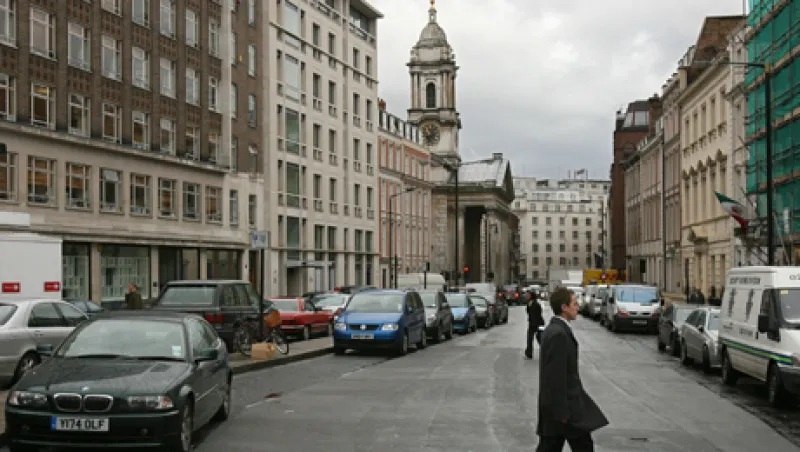
The eager masses thronging the iconic shopping district of London’s West End prove that for institutional investors in commercial real estate, there is safety in numbers. The clothes the customers are buying will go in and out of fashion, but the streets where they purchase them, including the hallowed names of Oxford, Regent and Bond (Old and New), will not.
The plush offices of nearby Mayfair, many of them occupied by hedge funds, are no less attractive to investors looking for real estate safe havens — those properties deemed likely to produce a steady income stream in the years ahead because their prime locations shelter them from the vagaries of the global economy.
Within Europe “there’s been a flow of capital from markets seen as volatile to safe havens,” says Joe Valente, European head of research and strategy for global real assets at J.P. Morgan Asset Management in London. “It is manifest in the stream of money going into the U.K., Germany and France,” he says. Since the 2008 collapse of Lehman Brothers Holdings triggered the global economic downturn, these three countries have accounted for about 70 percent of the $100 billion or so a year of European commercial real estate purchases made by investors, well above the long-term average of about 50 percent, Valente says.
This increasing concentration of investment in prime markets is taking place on the national level, too. “Investors are not just moving into safe havens in terms of countries. They’re also moving into safe havens within countries,” says Valente. He estimates that Germany’s top three markets — Berlin, Frankfurt and Munich — have attracted about 65 percent of all investment activity in the country since the Lehman collapse, up from a more typical proportion of about 50 percent. “This has left behind markets such as Hamburg, which in normal market conditions attract a lot of institutional money,” says Valente.
Analysts detect two great flows of money pouring into the European property market since the credit crunch began. One is from Asian investors, including sovereign wealth and pension funds, into prime locations within developed countries seen as having stable political and legal regimes. The other is from the troubled southern periphery of the euro zone to the healthier economies of the north.
When it comes to European safe havens, “the West End of London is perceived as the gold benchmark,” says Valente. DTZ, the global real estate advisory company with a Los Angeles headquarters, says London’s West End has the most expensive office property in the world, with a cost of $23,500 per workstation per annum. But property prices, like that of gold, can reach dizzying heights. Strong investor demand has pushed yields on some central London properties well below their long-term averages. Yields on the very best office properties in St James’s, a prime West End location that houses a number of corporate headquarters, are now about a half percentage point below the historical average of 5 percent, says Stephen Down, executive director for Central London and International in the London office of property services company Savills.
Yields are tumbling in other hot markets, too. In Munich, for example, yields on office and retail property currently stand at about 4.6 percent, compared with an average of 4.9 percent since the end of the 1980s. Howard Margolis, managing director for real assets at Morgan Creek Capital Management in New York, says that there have been transactions at yields of well below 5 percent in big, internationally focused cities in North America as well as in Europe.
Do these low yields pose a risk for institutional investors?
According to John Danes, a property specialist at Aberdeen Asset Management in London, the rise in prices is largely driven by overseas investors interested in “trophy assets — but domestic investors are more wary because prices have recovered so much from previous falls.” Because of this imbalance between foreign and domestic interest — sometimes taken in financial markets as a sign of an overbid sector — “for the first time in history, over 50 percent of London office property is overseas-owned.”
Danes questions whether the term safe haven is truly applicable to London because office property prices there “can be volatile.” Valente of J.P. Morgan concurs. “There are times when capital values in London have fallen dramatically,” he says. Between 2007 and 2011, prices for prime London commercial property fell by 50 to 60 percent, Valente says. However, looking at the average for the market as a whole, he says they have since risen by about 20 percent — a considerable rise, but not enough to return values to former levels. With prices at between £800 and £1,000 ($1,250 and $1,562) per square foot for prime office buildings, London is “not yet” in bubble territory, he says cautiously.
Margolis of Morgan Creek attributes the rise in prime property prices to the easy money policies of the Federal Reserve Board and other major central banks. Real estate prices in cities such as London, New York and San Francisco “feel very artificial because of global quantitative easing and the need for preservation of capital by families living in more volatile countries,” he says. He adds, “It’s very hard to make economic sense of investing in the expensive iconic properties, unless you’re a super-long-term holder.” Nevertheless, many institutional investors still see inherent safe-haven qualities in historical property hotspots, not washed away by the fall in yields.
They argue, for example, that in true safe havens, strong underlying demand tends to cause prices to bounce back eventually, even after significant falls. “If you’re a long-term investor, London is a relatively safe place to invest because high demand will boost prices and rents in the long term,” says Valente. Strong rent growth in London’s West End retail districts, for example, could allow landlords to increase very low initial yields at the time of purchase.
He adds that investors are not necessarily looking for high yields in property safe havens around the world: “The biggest reason for investing in these markets isn’t attractive pricing but diversification and wealth retention.”
Valente and other investors also refer to the superlative protection given to landlords in Britain. Standard leases contain upward-only rent reviews and require commercial tenants, rather than landlords, to pay for their own repairs and insurance. Such provisions minimize the risk of unexpected costs and ensure that yields, however low, are virtually guaranteed. “We have the most capital-friendly leases in the world,” says Simon Hope, London-based global head of capital markets and member of the Group Executive Board of Savills.
Margolis of Morgan Creek says that for those interested in holding for the extremely long term, even low-yielding prime properties can make sense if the investor “thinks in terms of decades and views them as a store of value or an insurance policy against instability in their home country.”
Nevertheless, the strong demand for safe-haven property assets has, say investors, created great opportunities in less prime locations that have been starved of capital. Margolis says investors can obtain yields of 8 to 10 percent in pockets of commercial property in the suburbs of major U.S. cities or in slightly smaller cities. Such bargains with the opportunity to grow yield,” as he calls them, include Richmond, Virginia, and Salt Lake City, Utah. “In the long-term the average differential between a prime asset and a secondary one is about 100 basis points,” says Valente of J.P. Morgan. “Currently the difference is nearly 500 basis points.” Even in Central London, investors can find yields of 6.5 percent if they are prepared to make some compromises in search of a higher return: opting for buildings with leases of under 10 years, he adds.