
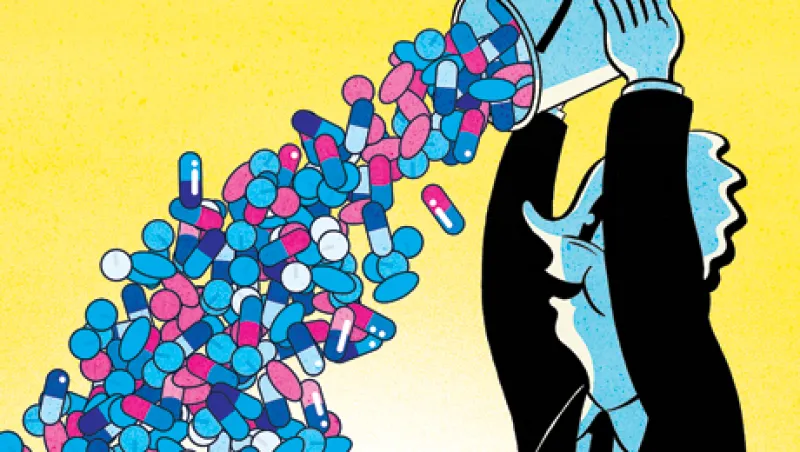
FOR MUCH OF THE PAST DECADE, the pharmaceuticals industry — and its investors — privately griped that the U.S. Food and Drug Administration was too tough. In 2008 the agency unexpectedly rejected Tredaptive, a Merck & Co. medication for cholesterol that should have been a shoo-in, as it merely combined old-staple niacin with an ingredient to prevent flushing. Two years later the FDA drastically restricted the usage of Avandia, a diabetes drug made by GlaxoSmithKline that was already on the market. And obesity drugs? Forget it. Sanofi-Aventis’ Acomplia was rejected in 2007; Abbott Laboratories pulled Meridia from the market in 2010 under FDA pressure. Clearly, almost nothing could get past the nitpicking regulators.
With old blockbusters like Pfizer’s $11 billion cholesterol drug Lipitor going off patent and their replacements long delayed at the FDA, investors couldn’t see much future in the sector.
But last year all of that seemed to shift: The agency approved 30 groundbreaking new drugs, compared with an annual average of just 22 over the previous half dozen years. Even more important in the FDA’s view, a record amount — 70 percent — were okayed without first being sent back to the manufacturer for more work. Within two days this past January, two innovative drugs, Genentech’s Erivedge for a type of skin cancer and Vertex Pharmaceuticals’ Kalydeco for cystic fibrosis, were waved through faster than anticipated. And in perhaps the ultimate symbol of change, the agency in late June approved Belviq from Arena Pharmaceuticals — the first new diet drug in 13 years.
“We’ve done a lot of things over the past 20 years to improve the efficiency of our review process,” says John Jenkins, the low-key director of the FDA’s office of new drugs, which oversees clinical trials and approvals. “But the main driver is going to be the quality of the applications.”
Industry officials and investors largely agree. They say the drugs in the pipeline are better, while new laws and a budget boost have given the FDA structural, financial, legal and personnel muscle. After 12 years of short-term, interim, controversial and weak leaders, Margaret Hamburg, a respected former New York City health official and bioterrorism expert, was appointed to head the agency in May 2009, providing some much-needed stability.

What happens at the FDA matters to investors for a crucial reason: Without the agency’s imprimatur, medications cannot be sold. If the FDA doesn’t have the staff to review the applications that pour in, the expertise to understand the trailblazing science behind some of the new products or the leadership to push back against political pressure, critical decisions will be delayed. In a typical year large pharmaceuticals companies might file 100 or more applications for approval of new drugs of all sorts. Even if only two or three of those are billion-dollar blockbusters — a reasonable assumption — that’s double-digit billions of dollars of revenue at stake.
Experts offer another explanation for the apparent changes at the agency, although Jenkins and some investors disagree. It was simply time, they say, for the historical pendulum of public pressure to swing away from caution and toward faster approvals.
“The FDA is trying not to be an impediment,” says Christopher-Paul Milne, a veterinarian and lawyer who is director of research at the Boston-based Tufts Center for the Study of Drug Development. The Tufts Center is considered one of the preeminent research institutions in the pharma field, in large part because of its statistics, despite the organization’s industry-friendly tilt. “Not so long ago the FDA would say, ‘The economic problems of the industry are not our problem,’ ” Milne notes. “Now they’re saying, ‘If there’s a productivity problem, we have to go back and revamp the way we do clinical development.’ ”
The 13,500 employees at the FDA — scattered across three cities in Maryland, an outpost in Arkansas and scores of local offices — oversee fully one fourth of the U.S. economy, from CAT scans to cat food to chemotherapy drugs. The bureaucracy consists of 16 main offices, eight scientific centers within them and divisions within those centers. Relatively weak when it was founded in 1906, the FDA through the years has gained authority over medical devices, drug advertising and the methods of testing new drugs on people. Most recently, it gained limited authority over tobacco products.
Within this bureaucracy, the most important constituents for the pharmaceuticals industry are the 3,300 people at the Center for Drug Evaluation and Research (CDER) and the 1,000 at the Center for Biologics Evaluation and Research (CBER), who approve and monitor new and generic drugs, vaccines and drug advertising. The main difference is that CDER oversees traditional so-called small-molecule drugs (which are usually made of chemical compounds), while CBER is in charge of drugs and vaccines manufactured in cultures of living cells. The latter group tends to include the newest, most innovative, most expensive and hardest-to-copy drugs.
To get a new drug of either type approved is a long, convoluted process that generally takes at least a dozen years of lab research, animal tests and human trials, and costs $1.3 billion, on average, according to Tufts (the most widely cited estimate). The companies confer with the FDA at various stages along the way, including preapproval, before starting human clinical trials. Typically, human trials are done in three stages — Phases 1, 2 and 3 — starting with tests for safety on a few dozen healthy volunteers and culminating in tests for safety and effectiveness on thousands of patients who have the condition the product is supposed to treat. In the classic situation — so-called double-blind, placebo-controlled trials — only half the patients get the actual drug, but neither they nor the investigators conducting the trial know who they are, so no preconceived bias taints the results. When the trials are finished, manufacturers submit their applications to Jenkins’s staff of reviewers for approval: a new drug application (NDA) for small-molecule drugs, or a biologics license application (BLA) for biologics. Under the law the agency has certain time limits for making its decision (more on that later), depending on whether the drug could be considered a priority drug that treats a life-threatening condition with few or no other remedies.
At least, that is the way the process is supposed to work.
Since the early 1990s the agency’s mandate has bounced back and forth as a result of competing pressures from patient groups, safety advocates, manufacturers, news reports and politicians to either speed up and get drugs to patients who need them or slow down and make sure the drugs are safe. The pendulum began swinging after Reagan-era budget cuts decimated staffing so badly that it took regulators two or three years to review new-product applications; the “speed” side of the pendulum took control, prompting Congress to pass the Prescription Drug User Fee Act (PDUFA) in 1992. The law aimed to accelerate the approval process in two ways: by levying fees directly on the drug companies that would go toward beefing up the review budget and by setting progressively tighter deadlines with each five-year renewal of the law, requiring faster approvals for priority drugs.
Then, after a dozen medications were recalled for safety problems between 1997 and 2001, consumer groups charged that the FDA had pushed approvals through too quickly, and the pendulum swung the other way, toward slow and safe. The next shift, back to the speedy side, came in the early 2000s, when patient advocacy groups complained that they couldn’t obtain medicines that were already available in Europe and news stories fretted about a “drug lag” because the FDA was too cautious and plodding.
The most recent emphasis on safety began in September 2004, when Merck pulled its heavily advertised painkiller Vioxx from the market after new trials showed that the $2 billion blockbuster caused serious cardiovascular problems. Because outsiders had raised safety concerns about Vioxx for years, and because Merck had always been seen as the most ethical of the big manufacturers, this became a pivotal moment for the FDA and its universe of onlookers. Even today, eight years later, “Vioxx” is shorthand for a safety scandal. Congress held hearings; horror stories tumbled out about other approved drugs. And there matters stayed, with the FDA almost paralyzed, at least until last year, most observers say.
“Clearly, there was a feeling that after Vioxx the pendulum had pushed too far,” says Behzad Aghazadeh, one of six partners at venBio, a San Francisco–based investment firm specializing in biotechnology.
The FDA’s Jenkins, whose office must approve all new NDAs and BLAs, insists that in his two decades at the agency he has never been directed or directed his staff to speed up or slow down. “We take each application on its own merits,” he says. Still, Jenkins concedes that reviewers and their supervisors may well feel pressure from outside. “It’s impossible for me to say that public controversies about the drug approval process don’t come into individual decision makers’ thinking about applications,” he says.
If the FDA got tougher post-Vioxx, the industry didn’t help its own case. “Drugs with insufficient proof were already so far along in development,” Aghazadeh says, “that companies continued, and of course they were rejected.” One reason the approval numbers look bad from 2005 to 2010 is that it took a few years for the weak candidates to work their way through the process.
The next crop in the labs would be markedly different: more targeted, more innovative, more focused on genuine needs. Partly, that’s thanks to the long-delayed promise of genomics. More than a decade after the human genome was first mapped, in 2000, showing the exact order of the 3 billion pairs of chemical units that provide the basic genetic instructions for human development, researchers have finally analyzed and uncovered enough to start turning this knowledge into products. The main goal is to find unusual spots or variants on the genome that seem shared among people with a particular medical condition. Then — at least, in theory — scientists could manipulate another biologic micro-organism or chemical compound to target those genetic variants, usually by latching on to them or disabling them. The drug companies have bolstered their R&D prowess by forming close partnerships with universities and other research institutions, even sharing lab space or financing academic studies into the middle stages of drug development (Institutional Investor, June 2011).
“The pharmaceuticals and biotech industries have gotten ever better in defining the patient population for whom their drugs are most likely to be beneficial and have minimal or no side effects,” says Jeffrey Jay, co-founder of Greenwich, Connecticut–based investment firm Great Point Partners, which runs a $250 million hedge fund and a $156 million private equity fund. Jay, a Boston University–trained medical doctor with an MBA from Harvard Business School, classifies the hedge fund as deep-value, focusing on small companies involved in medical devices, diagnostics and biotech.
In theory — and the FDA’s Jenkins agrees — genomics-based drugs should be easier for companies to test and for regulators to evaluate. If scientists find a genetic variant that seems to show up in the genome of people with a particular disease, then they only need to enroll people with those genetic markers in their clinical trials. That saves time and money by allowing smaller trials and should produce higher success rates. “The easiest drugs to approve,” Jenkins says, “are the ones that have dramatic benefits and not many risks.”
For instance, the FDA last year green-lighted Benlysta from GlaxoSmithKline and Human Genome Sciences — a genomics-based product and the first new treatment for lupus, an autoimmune disease, in more than half a century. Also last year, Pfizer won approval for Xalkori and a companion diagnostic test for people with a genetic mutation related to late-stage non-small-cell lung cancer.
And if Big Pharma didn’t see the handwriting on the prescription pad, insurance companies are making sure it does. Under pressure to control costs — even more so now that the Affordable Care Act has been upheld, requiring insurers to accept patients with expensive preexisting conditions — third-party payers have become less and less willing to cover expensive new drugs barely different from what’s already on the market. “The payer is asking questions like ‘What’s unique about the drug?’ and ‘How would your drug fare relative to standard of care?’ ” says C. Anthony Butler, senior health care analyst at Barclays Capital in New York. There’s little point in developing a “me-too” drug that is unlikely to be included on insurance company formularies, or lists of approved medicines, because doctors will simply prescribe rival products that are on the lists.
Moreover, FDA regulations promise speedier action on medications when they target diseases that have few or no other treatments. Of the 30 innovative new drugs approved in 2011, 12 were what’s called first-in-class — that is, the first treatments ever for a particular therapeutic condition — including novel treatments for hepatitis C and chronic obstructive pulmonary disease.
But investors shouldn’t get too excited. Even with all these practical inducements, pharma R&D remains a difficult and expensive slog. True, Tufts is recalculating its $1.3 billion estimate for the cost of developing a new drug on the theory that genomics ought to allow smaller and thus cheaper clinical trials. Nevertheless, Milne doesn’t expect the figure to change much when the recalculation is finished next year, mainly because so few drugs are based on this advanced science — no more than 20 on the market so far, he says.
With or without genomics, the number of applications for innovative drugs submitted to Jenkins’s office has zigzagged in no discernible pattern since 1999, from a low of 22 in both 2002 and 2010 to a high of 38 in 2005. The number of applications for new drugs of all sorts — including drugs similar to those already on the market — rose fairly steadily to a high of about 145 in 2009, then plunged to 103 the following year and 105 in 2011. The industry has not altered its basic prediction of success: For every 10,000 compounds that enter the R&D pipeline, only three will reach patients’ medicine cabinets.
Of course, it’s not only the industry that has gained tools. So has the FDA. Its outlays on new-drug reviews have nearly doubled, from $524 million in fiscal 2005 to $932 million in fiscal 2010 (the most recent statistics available). Moreover, “we’ve spent a lot of time and effort standardizing our review process and training our staff,” Jenkins says. For instance, in February 2010 the FDA and the National Institutes of Health (which focuses on basic research) announced a joint, $6.75 million, three-year initiative that aims to speed up the development process by, among other things, establishing an oversight committee to make sure researchers keep abreast of regulatory requirements while they’re puttering in their ivory towers. The FDA also has a new office of regulatory science, designed to help coordinate its review process.
One ironic twist comes from the Food and Drug Administration Amendments Act of 2007, which gives the agency the power to require companies to conduct additional clinical studies and change product labels even after a drug is on the market, to evaluate for possible “serious risk.” Before, the FDA could demand more tests only under limited circumstances, such as if a drug had been approved just on the basis of animal trials or if the company wanted authorization for use by children. The regulators had to beg, plead and negotiate with drugmakers to get labels altered. The new authority essentially extends the agency’s clout forever.
This might sound like Big Pharma’s worst nightmare. Yet many investors are perfectly happy with the law. Their reasoning: Regulators might be willing to approve drugs more quickly if they know they can demand a second bite of the review apple.
South San Francisco, California–based Genentech (now 100 percent owned by Switzerland’s Roche Holding) is currently going through this process, with seven postmarketing trials required for skin cancer medication Erivedge. Among other things, the company must analyze the impact on pregnant women and infants, as well as various drug-to-drug interactions. Michelle Rohrer, a Ph.D. in nutrition science who is the company’s vice president of regulatory affairs, would not disclose how much this added testing was costing in terms of time and money. In its first two months on the market, in the first quarter of 2012, Erivedge had sales of only $5.28 million. Still, Rohrer says, doing the extra testing now, while racking up those sales, is much better than having the drug sit around unapproved while the trials are conducted.
“When we have a product that we feel has that clinical-benefit risk profile, we would prefer to get that drug out to patients and approved as quickly as possible,” she says. “If that approval could come earlier, with realistic postmarketing commitments to follow, that would be our preference.”
Since the law’s passage the FDA has requested more than 385 postmarket studies. Great Point’s Jay would actually like to see the agency use this power more. “If they’re concerned they may not have enough data about safety but they see significant benefit, they can approve a drug with extensive follow-up required,” he says. If safety problems are subsequently discovered, “they can alter the approval or pull it back later.” After all, Tufts’s Milne points out, some side effects simply can’t be discerned before a drug is on the market — used for several years by tens of thousands of people rather than by the 1,000 or so in a trial, and mixed with other medications.
The FDA’s Jenkins isn’t so quick to buy that reasoning. “Psychologically, now that we know that those [extra trials] are requirements, does that have any influence on a close call?” he asks. “That’s one of those questions that’s really impossible to answer.”
Many investors and industry experts, and the FDA itself, are hopeful that changes outlined in the latest renewal of the user-fee law — a rare example of a bill that Republicans and Democrats in Congress were able to agree on and pass — will also increase the FDA’s efficiency. Certainly, the drug companies long ago dropped their opposition to being billed extra to support government operations that they were supposedly paying for already through taxes. By now the manufacturers and their investors have not only accepted the trade-off, they have also taken advantage of the negotiating power they acquire at every five-year renewal.
Their optimism this year may seem odd given that the newest bill essentially adds 60 days to the amount of time allotted to the review staff to make their decisions. But even under prior law, the agency could grant itself extensions via mechanisms such as “complete response letters,” or CRLs — which, contrary to their name, indicate that an application is not complete — so the stated deadlines might have been meaningless.
Far outweighing any negative impact of the longer deadlines, as investors see it, is a requirement for FDA officials to hold two additional meetings with manufacturers — one midway through the review process and one toward the end — to discuss topics such as “major safety concerns and preliminary review team thinking regarding risk management.” Ideally, if the FDA staff can tell companies about their concerns at these meetings, there will be enough time to get the application in shape to meet the final deadline and avoid surprising the companies with a flurry of last-minute CRL demands.
“The FDA is hoping to more consistently hit its approval deadlines and do so in an environment of heightened transparency,” says Michael Gregory, who runs two equity health care funds, totaling about $200 million, affiliated with Dallas-based Highland Capital Management.
Of course, words like “communication” and “transparency” are all well and good, but the truth is in the details. Genentech’s Rohrer, for instance, wants to know just which FDA staff will be present at these meetings and how much authority they will have. The law calls for supervisors, project managers and team leaders. She would like to see higher-ranking division directors or their deputies — that is, the people who lead the crucial subdivisions within CDER.
Nathan Fischel, a Harvard-trained oncologist who runs $80 million in three health-care-focused hedge funds at Dafna Capital Management in Los Angeles, homes in even more closely, judging the value of each meeting by the personalities of the participants, not just their titles. “The FDA might be keeping the cards so close to their chest that the company can’t interpret what the FDA is saying,” he warns. “You might have a [government] guy who sees it as a legal interaction, where they are just looking for defects in your argument.”
One significant benefit of the user-fee renewal is that it hikes the new-drug review budget. This time the industry has agreed to increase its fees by 6 percent, or $40 million, to cover about 130 new staff members. Now that the law has passed, the hiring can begin.
Still, more employees aren’t enough to push drugs through the pipeline. The employees also need to be trained. And in trying to lure the handful of qualified scientists who really understand the newest developments in regenerative or personalized medicine, the FDA suffers from the handicaps of any government agency, including low salaries, bureaucracy and political interference.
Though Jenkins doesn’t argue the salary point, he asserts that he can attract good candidates “who choose to work at FDA because of their commitment to the public health mission.” He says the agency is doing a lot to stay on top of the newest technology. It created teams of experts in fields like genomics and rare diseases to serve as resources for the rest of the staff, and employees are encouraged to get advanced training. Working with outside scientists, FDA staff last year developed special genetic markers that can distinguish among different types of stem cells.
The agency’s biggest need right now, Jenkins says, is a consistent standard for clinical trials that use pharmacogenomics, or genetically tailored drugs. One key question: If patients with a certain genetic marker seem to respond to a therapy, is there any point in testing the drug on patients without that marker?
Some investors and industry experts agree that the agency is managing to keep up with science. “The pace of understanding is improving rapidly,” says Viren Mehta, founder of Mehta Partners, a New York–based financial advisory firm specializing in health care. Barclays Capital’s Butler points to the steady budget hikes and white papers the agency has produced on genetic tests in the past year or so.
The newest version of PDUFA specifically promises to train FDA staff, set up more review teams and hold public meetings with “stakeholders” on some of the most advanced new technologies, including pharmacogenomics, biomarkers (biological markers that may indicate progress in treating a disease without a traditional cure) and meta-analysis of best practices (essentially, an analysis of all the analyses that have already been done). The Pharmaceutical Research and Manufacturers of America, or PhRMA, the industry’s trade association, hailed the new law for providing the agency “with appropriate staffing and resources to develop, through public input, new tools and methods to integrate emerging scientific data and techniques into the drug development and review process.”
Tufts’s Milne is more pessimistic than PhRMA about the FDA’s ability to lure top-notch scientists directly to its payroll. Instead, he says, the agency may need to change the way it uses its 50 advisory committees: panels of nonstaff academics, practicing physicians, and industry and patient representatives that are usually convened to make recommendations on the most-controversial or innovative drugs. “They may have to use the advisory committees more for classwide issues rather than beating up each drug so much,” Milne says.
For now most investors and manufacturers are enjoying their new honeymoon with the FDA. And there is not much in the foreseeable future that might mar this interlude. Some promising drugs will undoubtedly fail during the R&D stage, but that’s already baked into investors’ forecasts, and it would take an unimaginable string of failures to shake their basic faith in genomics. PDUFA’s new funding is basically protected for five years regardless of the political fights in Washington, although Congress could hack the rest of the FDA budget. The biggest threat is another disaster like Vioxx.
“We’re always one safety problem away from the pendulum swinging back in the other direction,” Jenkins says. • •
Fran Hawthorne is the author of Inside the FDA: The Business and Politics Behind the Drugs We Take and the Food We Eat (John Wiley & Sons).