In response to my latest dispatch on investing in gold, several readers posted some great questions on the strategy. For example: what percentage of assets should be in gold, and at what point should investors get out?
It’s a very difficult question for asset allocators, notes Shayne McGuire, portfolio manager for the GBI Gold Fund of the Austin-based Teacher Retirement System (TRS) of Texas, who also is managing director and head of global research at TRS. "At a 2009 gold symposium, a renowned global strategist said it might make sense to hold 1 percent in gold — but only sometimes. Then I went to a Hong Kong presentation last fall and a precious metals strategist said the percentage should be anywhere from 10 percent to 20 percent."
"This shows how Asians think about gold as a savings instrument, while for the U.S. gold is seen as a speculative asset," McGuire reasons. "Quite often it’s coupled with end of the world or some horrible situation — the idea of owning it because of a disaster."
Gold performs well when it’s 1, 2 or 3 percent of a pension fund’s portfolio, he says.
Another reader comments, "Income growth will continue apace, as will dividend growth, while gold, producing no income, will be left in the dust and will increasingly be accumulated only by central banks."
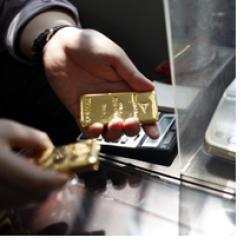

Adrian Ash, head of research at BullionVault of London, looks at central bank sales: "When the gold price was at a 25-year low in 1999, central banks were dumping gold. Britain sold 400 tons, half its gold reserves, as did the Swiss and the French. Of course, this has ground to a halt now, but big central banks in Europe continued dumping gold — 500 tons in 2004. Not all central banks sold — Germany and Italy never did."
"But central banks were selling at the bottom, and starting last year realized that they wanted to hold onto what they have," Ash continues. "Now the price is up four or five times from what they sold their gold at. It’s the first time in 20 years that European central banks have been buying gold — Russia has been doing so for the past five years."
Gold production is dependent the most on economics and when the price goes up, they simply bring more mines online. "Gold produces no income, and historically whipsaws in price. Furthermore, as Asian currencies become more stable, I think householders will actually sell their holdings," says one reader. Again, BullionVault’s Ash responds: "We’re not going to return to the gold standard. When world economies abandoned gold in the 1930s, it helped make recovery possible. Money supply is one element of the gold story."
In terms of gold mining, he notes that output rose seven percent last year, according to the GFMS Limited, a precious metals consultancy in London. "New reserves are becoming ever harder to find and at greater expense, too. GFMS now puts the all-in cost of a new mine (including infrastructure, schools, hospitals and other essentials) at $950 an ounce. Instead the action is in mergers and acquisitions. "It’s difficult to find the ore but easier to buy a gold company," And he ought to know. On June 21, the World Gold Council and Augmentum Capital, a growth fund backed by the Rothschild Investment Partners, RIT Capital Partners, announced an almost $20 million funding round in BullionVault.
How Are Pensions and Institutions Using Gold?
"I think that institutions will be a main driver in gold investment, taking a larger part of the gold pie," says TRS’s McGuire.
He is not alone. The World Gold Council (WGC), in its Gold Demand Trends report for Q2 2010 published today, found that investment demand was the strongest performing segment during the second quarter, posting a rise of 118 percent to 534.4 tons compared with 245.4 tons in Q2 2009. Further, it notes that the largest contribution to this rise came from the ETF segment of investment demand, which grew by 414 percent to 291.3 tons, the second highest quarter on record.
"The report states as well that 291 tons were purchased in just the last quarter," says Jason Toussaint, managing director for the U.S. at WGC, "and these statistics are absolutely astonishing." The investment section includes retail investment.
"Institutional investment shows a reawakening of the marketplace," he continues. "It was the forgotten asset when gold was linked to the dollar but the current state of investment markets globally, as well as ETFs making gold investable, are primary factors in its growth."
He sees a paradigm shift as having taken place with the introduction of gold ETFs. "With physical gold, there’s no price transparency — it’s not on an exchange — and there’s the quandaries where to store and how to insure. The SPDR GLD ETF traded a billion dollars on only the fourth day of its history. It’s been extremely successful."
Toussaint also points to the new report’s statistic — total gold demand in the second quarter rose by 36 percent to 1,050 tons, "and that’s at the same time period that the gold price was up 30 percent. "TRS’s McGuire sees gold investments looking increasingly intriguing to any major pension fund over $10 billion in assets. His own interest in gold began around 2003 and grew with his reading about the shiny ore. It’s translated into "Hard Money," a book he authored that will be out in a few weeks. It’s his second, "Buy Gold Now," was published in March 2008.
The main reason to own gold is diversification, he says. "While the stock market has been having a rough day lately, gold is up."
McGuire also is of the opinion that gold shouldn’t be called a commodity. "While it’s highly correlated with oil in good times, gold is also a currency. And it’s been strong, moving up even when other commodities are down." He adds, "We have to acknowledge that gold is a rock, which means that it does not produce a cash flow. But the important thing to consider, which I believe few do, is that gold performs extremely well within a portfolio setting: When one holds a small position in gold (say 1-3 percent of a portfolio), it benefits a portfolio over time. It helps the portfolio when stocks are down, and when stocks (the majority of a portfolio) are up, you don't care if gold is down."
For example, he noted that copper was down two percent in late August, oil down one percent but gold and silver have remained buoyant. "It’s acting like currencies," he says. Interestingly, in 2008 all industrial commodities collapsed but gold was up.
Janice Fioravante is a financial writer whose work has appeared in the New York Times and the Harvard Business Review.